
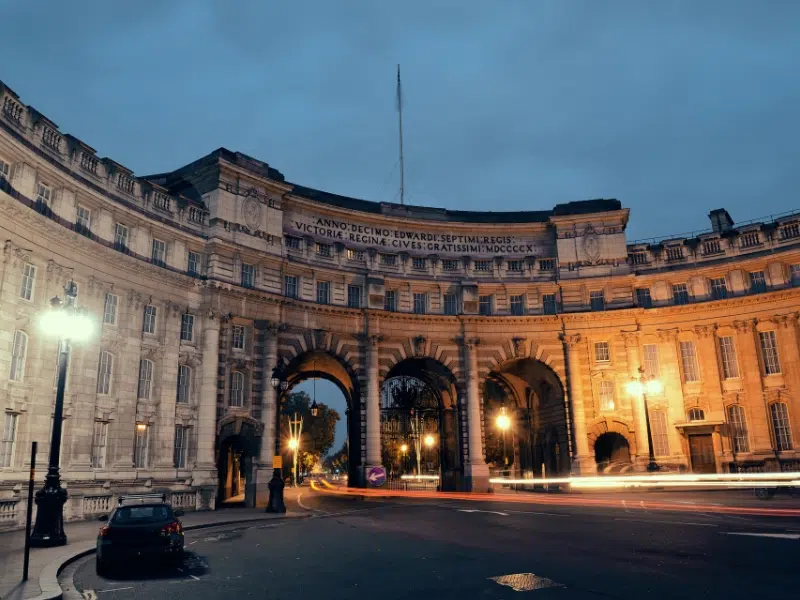
Admiralty Arch is the grand curved gateway between Trafalgar Square and The Mall, the ceremonial avenue that leads to Buckingham Palace. King Edward VII commissioned it in memory of his mother, Queen Victoria, and it was completed in 1912. Part triumphal arch, part office building, it housed the Admiralty and other government departments for a century and is now being turned into a luxury hotel.
Admiralty Arch at a glance
- Where: on the south-west side of Trafalgar Square, at the start of The Mall.
- Built: completed in 1912; the Latin inscription on top is dated 1910.
- By: the architect Aston Webb, who also designed the Victoria Memorial and the present facade of Buckingham Palace at the far end of The Mall; built by John Mowlem & Co.
- What it is today: a Grade I listed building being converted into the Waldorf Astoria London hotel, expected to open in late 2026 or 2027; the road and footpaths still pass through its arches.
- Time needed: 10–15 minutes to look at the arch from both sides; longer if you walk down The Mall.
A memorial that became an office block
Edward VII commissioned the arch as part of a national memorial to Queen Victoria, which also included the Victoria Memorial in front of Buckingham Palace. He died in 1910 and did not see it finished. Because it adjoins the Old Admiralty Building, it took the name Admiralty Arch, and for decades its wings held Admiralty offices and the official residence of the First Sea Lord; Louis Mountbatten was among those who lived there.
From 2000 the Cabinet Office used the building, until it was emptied in 2011 as part of government spending cuts. In 2012 it was sold on a 125-year lease for about £60 million to be redeveloped as a hotel. After years of planning and changes of owner, the conversion into a Waldorf Astoria hotel with rooms, residences and a ballroom has been under way, with the opening expected in late 2026 or 2027. Underneath lies a warren of tunnels and vaults that once held government archives.
What to look for
- The asymmetry: seen from The Mall, the right-hand wing has one more floor below the cornice than the left.
- The Latin inscription along the top, which records the dedication to Queen Victoria in the tenth year of Edward VII's reign by "most grateful citizens".
- The statues of Navigation (left) and Gunnery (right) at the ends of the wings, by the sculptor Thomas Brock.
- The three arches: the central one, with its iron gates, is reserved for royal and ceremonial use, while traffic and pedestrians use the side arches.
- The nose: on the inside wall of the northernmost arch, at about seven feet, sits a small nose placed there in 1997 by the artist Rick Buckley.
Noses and secret passages
Rick Buckley attached his nose in 1997 as a protest against the growing "Big Brother" surveillance society, and it has survived ever since, at waist height for a rider on horseback. Stories have grown up around it, but its real origin is that small art protest. Another long-repeated rumour claims an underground passage links Admiralty Arch with 10 Downing Street; it has never been confirmed.
Tips for your visit
- For the classic view, stand in The Mall and look back towards the arch with Nelson's Column rising behind it.
- Look for the nose from the pavement under the northern arch; it is easy to miss unless you look up a little.
- On ceremonial days, such as Trooping the Colour, The Mall is closed and crowded, so check the calendar before you go.
- Combine the arch with a walk down The Mall to Buckingham Palace, through St James's Park.
Nearby
- Trafalgar Square: the square with Nelson's Column and the lions, right outside the arch.
- National Gallery: one of the world's great collections of European paintings, on the north side of Trafalgar Square.
- Horse Guards Parade: the parade ground behind Whitehall, home of Trooping the Colour.
- St James's Park: the royal park along The Mall, with its lake and pelicans.
See London with World City Trail
Our London scavenger hunt turns the city centre into a game you play on your phone. The route links 10 stops and takes around 3 hours, with about 58 minutes of walking. It includes Big Ben and Westminster and Parliament Square. You can play in English, German, French, Italian, Spanish and Dutch.
If you prefer a different format, there is also a self-guided walking tour and an outdoor escape game in London.
Play the London scavenger hunt →
Take the self-guided walking tour of London →
Play the outdoor escape game in London →
Facts checked in October 2026.