
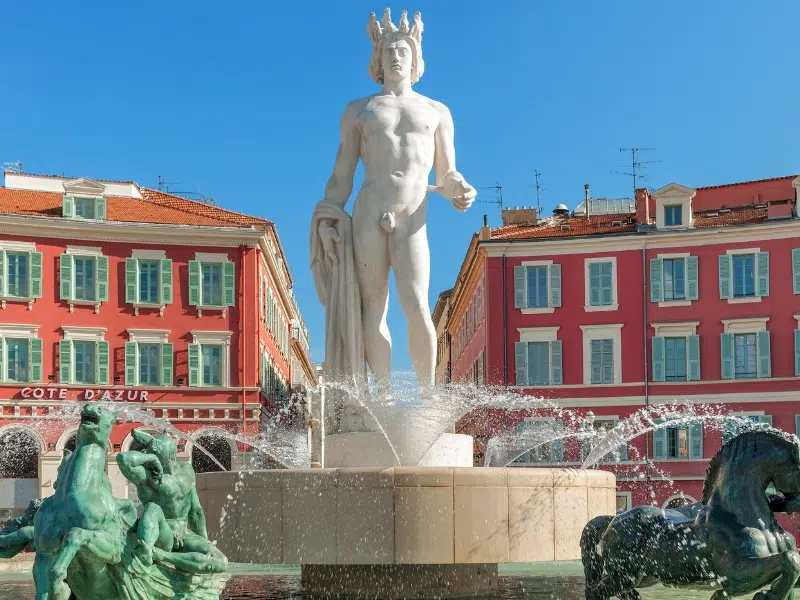
The Fontaine du Soleil (Fountain of the Sun) stands at the southern end of Place Masséna, the main square of Nice, between the old town and the Jardin Albert Ier. Its centrepiece is a seven-metre marble Apollo by the sculptor Alfred Janniot, surrounded by bronze figures of the planets. Few statues have had a stranger career: Apollo was banished from the square in the 1970s and only came back in 2011.
The Fontaine du Soleil at a glance
- Where: Place Masséna, at the southern end of the square by the Jardin Albert Ier, a short walk from the old town and the Promenade des Anglais.
- Created: begun before the Second World War and unveiled in 1956; complete again since 2011.
- By: the French sculptor Alfred Janniot.
- What it is today: a working fountain and one of the best-known meeting points in the centre of Nice.
- Time needed: 10–15 minutes, more if you combine it with a look around Place Masséna.
Apollo's long exile
Janniot, a sculptor known for large reliefs on public buildings, started work on the fountain before the Second World War. He had finished the five bronzes but not yet begun the Apollo when the war broke out, and the bronzes were buried in a garden for safekeeping and dug up afterwards. The fountain was finally unveiled on Place Masséna in 1956, with a white marble Apollo about seven metres tall and weighing around seven tonnes.
Not everyone was pleased. Some people found the naked god indecent, students played pranks on him, and a correction with hammer and chisel did not end the complaints. In the 1970s, after a campaign by a Catholic women's group, Apollo was taken away and ended up at the Charles-Ehrmann sports stadium. The fountain itself was later dismantled, and the bronze planets were stored at a water treatment plant. When the tramway works reshaped the square in the 2000s, the fountain was rebuilt with its bronzes, and in 2011 Apollo finally returned to the middle of the basin.
What to look for
- Apollo's crown: instead of driving a chariot, the sun god wears his four horses on his head.
- The five bronze figures in the basin, representing the Earth, Mars, Venus, Mercury and Saturn.
- The contrast of materials: white marble for Apollo, dark bronze for the planets around him.
- The red-ochre façades and arcades of Place Masséna behind the fountain, built in the 19th century over the covered Paillon river.
- The sculptor Jaume Plensa's seven kneeling figures on tall poles across the square, which light up in changing colours after dark.
The 'four horsepower' statue
Nice soon found a nickname for the new Apollo. Because of the four horses on his head, he was called the 'four horsepower' statue, a joke on the Renault 4CV, the small car that was everywhere in France in the 1950s. The nickname is folklore rather than an official name, but it shows how quickly the statue became part of everyday life on the square, long before the quarrel over his nudity sent him into exile.
Tips for your visit
- Come in the evening, when the square is lit and the Plensa figures change colour; mornings are quieter for photos of the fountain.
- Walk round the basin to see each of the five planets up close: they are easy to miss next to Apollo.
- Watch out for trams: the line crosses Place Masséna, and they are almost silent.
- Combine the fountain with a stroll along the Promenade du Paillon park, which starts right next to the square.
Nearby
- Vieux Nice: the narrow lanes of the old town begin just south-east of the square.
- Cours Saleya: the old-town square of the flower and produce market, a few minutes' walk away.
- Promenade du Paillon: the long park laid out over the covered Paillon river, with the Miroir d'eau, a shallow pool with water jets.
- Promenade des Anglais: Nice's seafront promenade, a few minutes' walk south through the Jardin Albert Ier.
See Nice with World City Trail
Our Nice scavenger hunt turns the old town into a game you play on your phone. The route takes around 2 hours, with about 35 minutes of walking, and leads you through the streets around the old town at your own pace.
If you prefer a different format, there is also a self-guided walking tour and an outdoor escape game in Nice.
Play the Nice scavenger hunt →
Take the self-guided walking tour of Nice →
Play the outdoor escape game in Nice →
Facts checked in October 2026.