

Table of Contents
The Arch of Galerius, or Kamara, in Thessaloniki, Greece, stands as a majestic and historically significant monument, offering a tangible link to the city’s Roman past. More than just a structural relic, this grand triumphal arch embodies the grandeur of Roman imperial architecture, the strategic importance of Thessaloniki during Late Antiquity, and the artistic mastery of its time. It is a place where historical narratives, artistic expressions, and urban heritage converge, offering visitors a profound journey into the city’s ancient roots.
A Glimpse of History
The Arch of Galerius was constructed in the early 4th century AD to commemorate Emperor Galerius’s decisive victory over the Sassanid Persians in 297 AD. As part of a larger imperial complex that included Galerius’s Palace and the Rotunda, the arch played a central role in imperial propaganda, reinforcing Thessaloniki’s importance as a Roman administrative and military hub. Located at a strategic crossroads of major Roman trade routes, the arch was not merely a monument but a ceremonial gateway, symbolizing Rome’s power and military supremacy in the East.
Architectural Brilliance
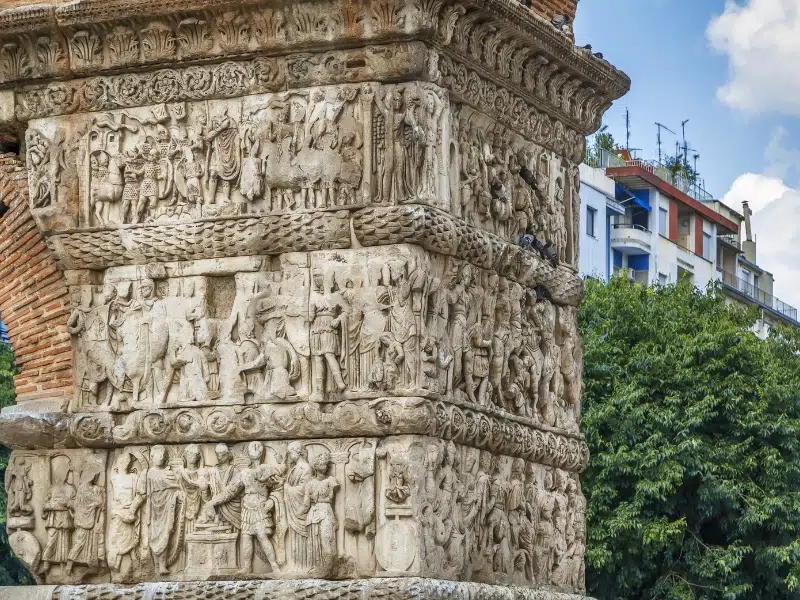
The Arch of Galerius is a masterpiece of Roman engineering, constructed with a brick core covered in elaborate marble relief panels. The structure originally featured eight piers, forming a large central archway and two smaller side arches, of which only parts remain today. The now-missing sections once connected the arch to a colonnaded walkway, leading towards the Palace of Galerius.
The most striking feature of the arch is its intricate relief carvings, which depict scenes of Galerius’s military campaigns. These elaborate friezes showcase:
- Dramatic battle scenes, portraying the emperor and his legions in combat.
- Victory processions, symbolizing the power and divine favor of the emperor.
- Deities and personifications, reinforcing Roman religious and political ideology.
Despite centuries of erosion, these reliefs remain one of the finest examples of Roman imperial art in Greece, offering insight into how Rome used monumental architecture as a political tool.
A Monument Witnessing Centuries of Change
The Arch of Galerius has stood the test of time, witnessing dramatic transformations in Thessaloniki’s history. It survived the Byzantine era, when the city flourished as the second-most important metropolis of the Eastern Roman Empire. Under Ottoman rule (1430–1912), Thessaloniki saw many architectural changes, yet the arch remained a landmark of the city.
As Thessaloniki expanded in the modern era, the arch became an integral part of the urban fabric, blending antiquity with modern city life. Today, it stands at the intersection of Egnatia Street and Dimitriou Gounari Street, surrounded by a vibrant mix of historical sites, cafés, and shops, serving as a meeting point for locals and tourists alike.
A Timeless Connection
The Arch of Galerius is more than just an ancient ruin—it is a living monument, embodying Thessaloniki’s Roman legacy, artistic excellence, and urban evolution. It serves as a testament to the city’s enduring historical significance, standing as a bridge between the past and present.
Whether admired for its architectural splendor, historical depth, or cultural symbolism, the Arch of Galerius continues to be a defining landmark of Thessaloniki, inviting visitors to explore, reflect, and connect with the city’s rich and multifaceted past.

Arch of Galerius is part of Thessaloniki scavenger hunt and walking tour!
Embark on an unforgettable journey through the enchanting city of Thessaloniki with World City Trail. Our interactive walking tour combines the thrill of exploration with the rich history and culture of this beautiful city.
Key Features:
Interactive gameplay: Solve engaging puzzles and challenges as you explore the city.
Hidden gems: Uncover lesser-known spots.
Cultural insights: Learn about the city’s fascinating history.
Flexibility: Explore at your own pace and create your own itinerary.
Family friendly activity and a great way to explore the city!
Further reading on Wikipedia: Thessaloniki