
St George's Square is the main square of Valletta, right in the middle of the city on Republic Street. Most locals call it Palace Square, because one whole side is taken up by the Grandmaster's Palace, the seat of the Knights of St John and today the office of the President of Malta. For more than four centuries it has been the stage for the island's ceremonies, protests and turning points, including the presentation of the George Cross to Malta in 1942.
St George's Square at a glance
- Where: on Republic Street in the centre of Valletta, between Old Theatre Street and Archbishop Street, next to Republic Square.
- Created: probably laid out under Grand Master Hugues Loubenx de Verdalle (1582–1595); pedestrianised and repaved in 2009.
- What it is today: a pedestrian square used for ceremonies, festivals and concerts, framed by the Grandmaster's Palace, the Main Guard and the Casino Maltese.
- Time needed: 15 minutes for the square, 1.5 to 2 hours if you also visit the palace.
From slave market to state ceremonies
Before the Knights founded Valletta in the 1560s, this was farmland, as excavations in 2009 showed. Under the Knights the square became the centre of the new city. In 1615 a fountain fed by the new Wignacourt Aqueduct was inaugurated here, bringing water to Valletta for the first time; that fountain now stands in St Philip's Garden in Floriana. The square was also darker than its stately buildings suggest: it served as a slave market, and slaves were publicly flogged here. Carnival celebrations took place on the same stones.
During the brief French occupation it was renamed Place de la Liberté, and on 17 January 1799 the priest Dun Mikiel Xerri and other Maltese rebels were executed here. Under British rule it became the parade ground for the changing of the guard. On 7 June 1919, the Sette Giugno riots against British rule ended with Maltese protesters shot dead nearby, and on 13 September 1942, in the middle of the wartime siege, the George Cross awarded by King George VI to the people of Malta was formally presented in the square. From the 1980s it served as a car park until its restoration in 2009.
What to look for
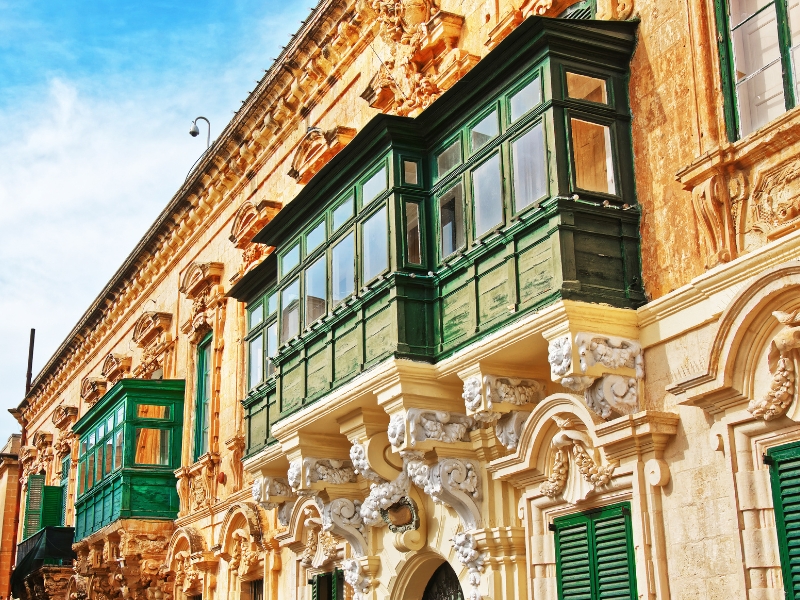
- The Grandmaster's Palace: the long facade on the southeast side, with two main doorways and wooden balconies, built from the late 16th century and mostly shaped in the 18th.
- The Main Guard: the building opposite the palace, with a columned portico added by the British in 1814, the British royal coat of arms and a Latin inscription saying the love of the Maltese and the voice of Europe confirmed these islands to Great Britain.
- The fountains: two 18th-century fountains from the time of Grand Master de Rohan flank the Main Guard, while water jets set into the paving have played in the middle of the square since 2009.
- The Sette Giugno monument: a memorial near the northwest end to the Maltese killed in the riots of 1919, back in the square since 2016.
- Casino Maltese: the former treasury of the Knights on the southwest side, now a private members' club.
The day of the George Cross
In April 1942 Malta was one of the most heavily bombed places on earth. On 15 April King George VI wrote by hand that he was awarding the George Cross to the island fortress of Malta, to bear witness to the heroism and devotion of its people. The medal was presented in this square on 13 September 1942. A replica of the George Cross now appears on Malta's national flag, and the original is kept on public display in the National War Museum at Fort St Elmo.
Tips for your visit
- Come in the morning before the cruise crowds, or in the evening when the square is quieter and the palace facade is lit.
- Watch for events: concerts, flower festivals and ceremonies are regularly held here, and parts of the square can be fenced off for them.
- Visit the Grandmaster's Palace for the state rooms and the Palace Armoury; parts may close for official functions, so check before you go.
- Combine the square with St John's Co-Cathedral and the Upper Barrakka Gardens, both a short walk away.
Nearby
- Republic Square: the square next door with the statue of Queen Victoria, the National Library and the café tables of Caffe Cordina.
- St John's Co-Cathedral: the Knights' conventual church with its gilded Baroque interior and two paintings by Caravaggio, a few minutes' walk away.
- Parliament and City Gate: Renzo Piano's modern parliament building and the gate at the top of Republic Street, about ten minutes on foot.
- Upper Barrakka Gardens: terraced gardens above the Grand Harbour with views of the Three Cities.
See Valletta with World City Trail
Our Valletta scavenger hunt turns the city into a game you play on your phone. The route links 10 stops and takes around 3 hours, with about 45 minutes of walking, and includes places such as the Triton Fountain, the Parliament building and the Upper Barrakka Gardens.
If you prefer a different format, there is also a self-guided walking tour and an outdoor escape game in Valletta.
Play the Valletta scavenger hunt →
Take the self-guided walking tour of Valletta →
Play the outdoor escape game in Valletta →
Facts checked in October 2026.