
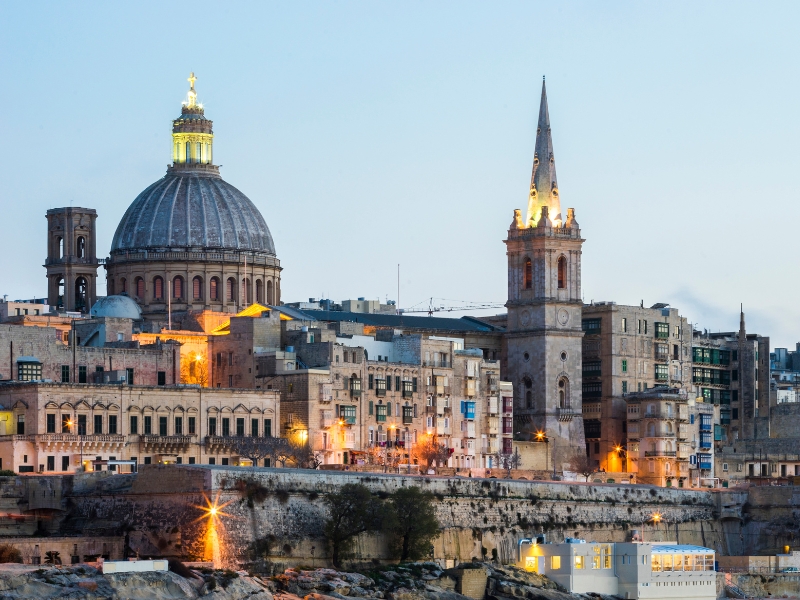
St Paul's Pro-Cathedral is the Anglican church on Independence Square in Valletta whose tall spire, more than 60 metres high, is one of the city's best-known landmarks seen from the harbour. It exists because of a queen: Adelaide, widow of King William IV, wintered in Malta in 1838–1839, found no Anglican church on the island and paid for one herself.
St Paul's Pro-Cathedral at a glance
- Where: Independence Square (Pjazza Indipendenza), on the Marsamxett side of Valletta, a few minutes from Republic Street.
- Built: 1839–1844; foundation stone laid by Queen Adelaide on 20 March 1839, dedicated on 1 November 1844.
- By: Richard Lankesheer drew the first plans; William Scamp redesigned and completed the church from 1841.
- What it is today: a working Anglican church and one of the three cathedrals of the Church of England's Diocese in Europe, restored between 2017 and 2024.
- Time needed: 20–30 minutes inside, if the church is open.
A queen's church on a knight's auberge
Before the church was built, Anglican services in British Malta were held in a room of the Grand Master's Palace. Queen Adelaide decided that was not good enough, and the church was built on the site of the Auberge d'Allemagne, the former residence of the German knights of the Order of St John. Its basement remains became the church's under-croft. The first design, by Richard Lankesheer, proved unstable, and in 1841 work restarted on plans by William Scamp, who gave Valletta a neoclassical church with an Ionic portico and the spire that changed the city's skyline.
During the Second World War the church was hit: the roof partly collapsed, but most of the building survived. On 2 December 1949 the Archbishop of Canterbury, Geoffrey Fisher, held a dedication here in the presence of Princess Elizabeth, then living in Malta. A long restoration of the building and the spire, launched in 2017, was completed in 2024 and won an award from Din l-Art Ħelwa, Malta's heritage trust.
What to look for
- The spire: rising over 60 metres, it is best seen from Marsamxett Harbour or the Sliema ferry, where it stands next to the dome of the Carmelite church.
- The portico: six Ionic columns in honey-coloured Maltese limestone. Inside, the nave columns have Corinthian capitals.
- The organ above the entrance: it came from Chester Cathedral in England, where it was built in 1684 by Bernard Smith. Tradition says Handel played it in Chester in 1742 on his way to Dublin for the first performance of Messiah.
- The war memorials: oak panels around the high altar honour the Allied units that defended Malta from 1940 to 1943, and twelve flags of units such as the RAF, the Royal Navy and the Merchant Navy hang in the aisles.
- Queen Adelaide's banner, hanging above the choir stalls.
- The quire and rood screen with the pulpit, dedicated to the memory of Sir Winston Churchill.
Why a pro-cathedral?
A pro-cathedral is a church that serves as a cathedral without being the bishop's main seat. The Diocese in Europe covers Anglican congregations across the continent, and its bishop's cathedral is in Gibraltar. St Paul's in Valletta shares the role of cathedral with it, which is why it has a dean and canons rather than an ordinary parish priest.
Tips for your visit
- It is a working church: check whether it is open before you go, keep your voice down and avoid wandering during services.
- For the classic view of the spire and the Carmelite dome side by side, look back at Valletta from the Sliema ferry or the Marsamxett waterfront.
- Combine it with the Manoel Theatre and the Carmelite church, both within a couple of minutes' walk.
Nearby
- Basilica of Our Lady of Mount Carmel: the Carmelite church next door, whose large dome sits beside the Anglican spire on the skyline.
- Manoel Theatre: Valletta's 18th-century theatre on Old Theatre Street, one of the oldest working theatres in Europe.
- Grandmaster's Palace: the seat of the Grand Masters of the Order of St John and later of the British governors, a few minutes' walk away.
- Casa Rocca Piccola: a 16th-century noble house on Republic Street, still lived in by the family that shows visitors round.
See Valletta with World City Trail
Our Valletta scavenger hunt turns the old town into a game you play on your phone. The route links 10 stops and takes around 3 hours, with about 45 minutes of walking. It includes the Triton Fountain, the Parliament building and the Upper Barrakka Gardens.
If you prefer a different format, there is also a self-guided walking tour and an outdoor escape game in Valletta.
Play the Valletta scavenger hunt →
Take the self-guided walking tour of Valletta →
Play the outdoor escape game in Valletta →
Facts checked in October 2026.