
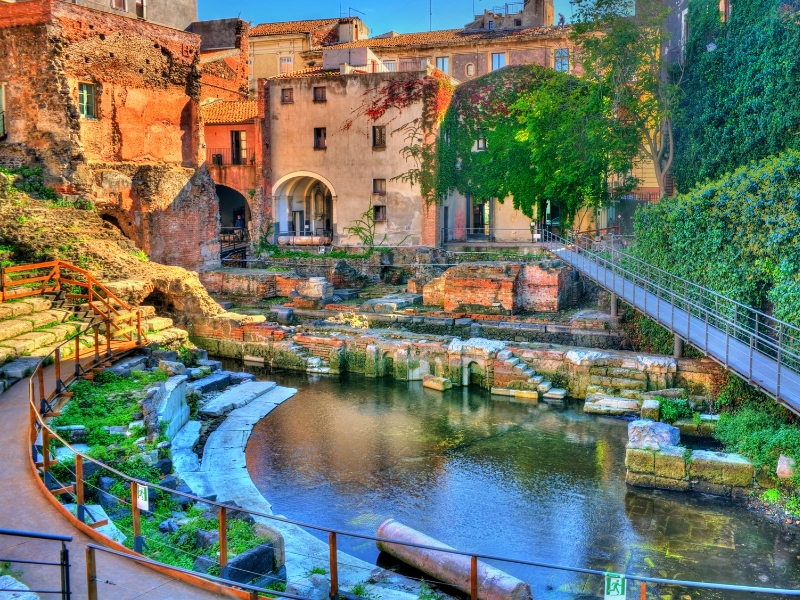
Catania's Greek-Roman Theatre is a large ancient theatre hidden behind the house fronts of Via Vittorio Emanuele, in the middle of the historic centre. What you see is mostly Roman, from the 1st and 2nd centuries AD, built of dark volcanic stone on the site where a Greek theatre probably stood. Its strangest feature lies at the bottom: the orchestra is often under water, fed by an underground spring that tradition links to the buried Amenano river.
The Greek-Roman Theatre at a glance
- Where: Via Vittorio Emanuele II, between Piazza San Francesco and Via Teatro Greco, in Catania's historic centre. From the street you only see an ordinary row of houses.
- Built: probably on the site of an older Greek theatre; the Roman building dates mainly from the 1st and 2nd centuries AD.
- What it is today: part of the Greek-Roman archaeological park of Catania, together with the smaller Odeon next door and two old houses, Casa Liberti and Casa Pandolfo, that display finds from the site.
- Time needed: 45 minutes to an hour for the theatre and the Odeon.
From Greek assembly place to buried ruin
Ancient writers record that the Athenian general Alcibiades spoke to the people of Katane in their theatre in 415 BC, trying to win them over against Syracuse. Whether that Greek theatre stood exactly here is still debated, but excavations found an older building of large sandstone blocks beneath the Roman one, and locals still call the site 'Tiatru grecu'. In the 1st century AD, probably after Augustus made Catania a Roman colony, the theatre was rebuilt with squared lava blocks. In the 2nd century it was enlarged with a marble-clad stage, and it could seat around 7,000 spectators.
The theatre fell out of use in the 5th or 6th century. In 1098 the Norman Count Roger had marble and stone taken from it for the new Cathedral of Sant'Agata, and over the centuries houses were built over and into the seating, while lava flows and earthquakes raised the ground around it. Digging began in the 18th century under Ignazio Paternò Castello, Prince of Biscari, but the last houses inside the ruins were only cleared in 1959.
What to look for
- The flooded orchestra: the semicircle at the bottom is often covered by clear water from an underground spring, which is why the theatre cannot be used for performances.
- The seating: rows of dark lava stone climbing up the slope of the hill, divided into wedges by stairways. Sit at the top to understand the scale.
- The corridors: vaulted passages under the seats, which led spectators to their places. They are cool and shady even on hot days.
- The houses on the rim: old houses still sit on the edge of the ruins, their balconies hanging over the seating. Casa Liberti shows marble fragments and other finds from the excavations.
- The Odeon: the smaller semicircular theatre right next to the large one, with a much smaller audience and a marble-paved orchestra.
Catania's buried river
The Amenano was once an open river in Catania, but over the centuries lava flows covered it, and today it runs hidden beneath the old town. It only comes to the surface in a few places. The best-known is the Fontana dell'Amenano in Piazza del Duomo, where its water spills over the rim of a marble basin in a smooth sheet that Catanians call 'acqua a linzolu', water like a bed sheet. The pool in the orchestra of the theatre is said to come from the same underground streams.
Tips for your visit
- There is little shade among the ruins, so in summer come early in the morning or in the late afternoon.
- Wear shoes with a good grip: the lava steps are uneven and can be slippery, especially near the water.
- Look out for the entrance on Via Vittorio Emanuele; the theatre is invisible from the street, and it is easy to walk straight past it.
- Combine your visit with Via dei Crociferi and the Bellini Museum, both a couple of minutes away.
Nearby
- Museo Civico Belliniano: the house where the composer Vincenzo Bellini was born, on Piazza San Francesco, a few steps from the theatre entrance.
- Via dei Crociferi: one of Catania's finest Baroque streets, lined with churches and convents, just around the corner.
- Monastero dei Benedettini: the huge former Benedictine monastery of San Nicolò l'Arena, now part of the university, a short walk uphill.
- Piazza del Duomo: the cathedral, the lava-stone elephant of the Fontana dell'Elefante and the Fontana dell'Amenano, a few minutes' walk away.
See Catania with World City Trail
Our Catania scavenger hunt turns the historic centre into a game you play on your phone. The route links 10 stops and takes around 2 hours, with about 34 minutes of walking, and includes places such as the Roman Amphitheatre, Piazza Stesicoro and Via Etnea. You can play in English, German, French, Italian, Spanish or Dutch.
If you prefer a different format, there is also a self-guided walking tour and an outdoor escape game in Catania.
Play the Catania scavenger hunt →
Take the self-guided walking tour of Catania →
Play the outdoor escape game in Catania →
Facts checked in October 2026.