
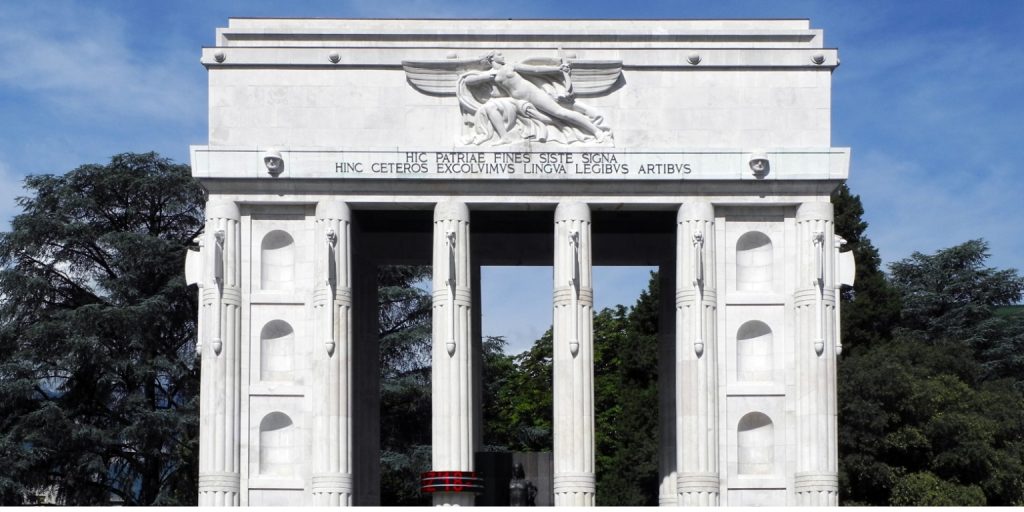
Standing prominently The Victory Monument in Bolzano is one of the city’s most striking yet intensely controversial landmarks. Far from being a universally celebrated monument, this imposing structure embodies the deeply complex history of South Tyrol, a region annexed by Italy after World War I, and serves as a powerful reminder of a turbulent past and the ongoing process of reconciliation.

A Symbol of Italianization: Its Origins and Construction
The Victory Monument in Bolzano was conceived and commissioned during the Fascist regime in Italy. Its construction was a direct consequence of the Treaty of Saint-Germain-en-Laye in 1919, which formally transferred South Tyrol (Südtirol), a predominantly German-speaking region of the former Austro-Hungarian Empire, to Italy. The monument was intended to celebrate Italy’s victory in World War I, commemorate its fallen soldiers, and, crucially, symbolize the “Italianization” of the newly acquired territory.
Designed by the renowned Italian architect Marcello Piacentini, a leading figure in Fascist architecture, the monument is a prime example of Italian Rationalist architecture, characterized by its monumental scale, classical elements, and powerful symbolism. Its construction began in 1926, and it was officially inaugurated on May 24, 1928, the anniversary of Italy’s entry into World War I. Piacentini chose a site on the Eisack River, near a bridge leading into the city center, ensuring its visual dominance.
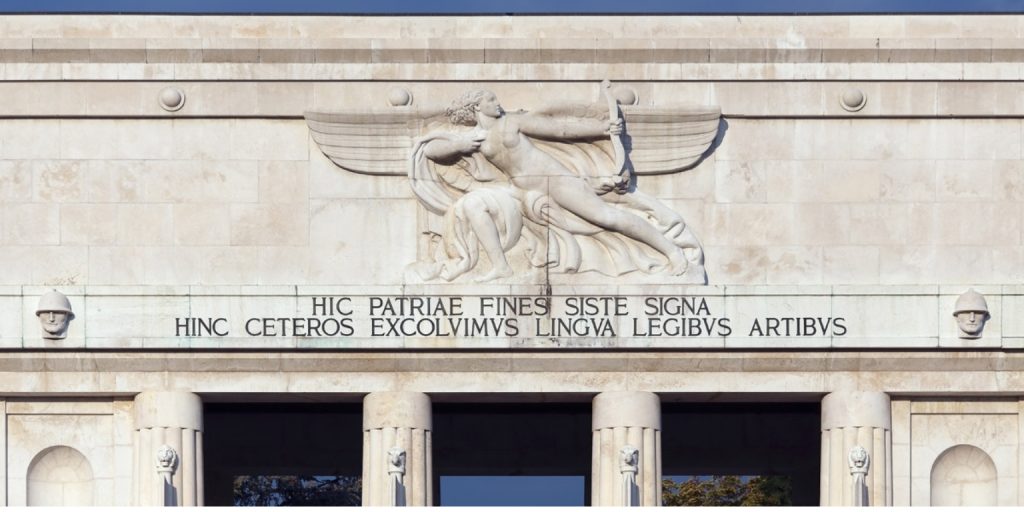
The monument’s imposing arch features colossal Fascist-era reliefs, Roman fasces, and triumphal inscriptions. Six prominent marble figures, sculpted by the artist Arturo Dazzi, represent allegories of victory and sacrifice. The dedication inscription, “Hic patriae fines sisti et signa hinc referte victoribus” (Here are the borders of the homeland, from here raise the victorious standards), clearly articulated its triumphalist and annexationist message.
A Source of Deep Controversy
From the moment it was conceived and throughout its existence, the Victory Monument has been a profound source of contention and pain for the German-speaking population of South Tyrol. For them, it was not a symbol of victory but of forced assimilation, the suppression of their cultural identity, and a painful reminder of the Fascist regime’s policies. These policies included the outlawing of the German language, the suppression of German schools, and the forced Italianization of surnames.
Re-contextualization and Reconciliation
In the early 21st century, as South Tyrol moved towards greater autonomy and a more stable, reconciled relationship between its linguistic groups, there was a concerted effort to address the monument’s controversial legacy in a constructive way. Rather than demolishing it, the local authorities, in collaboration with historians and cultural institutions, opted for a path of re-contextualization.
A permanent exhibition, titled “BZ ’18–’45: One Monument, One City, Two Dictatorships,” was opened within the underground crypt of the monument itself on February 4, 2014. This exhibition, designed to present the monument’s history, the Fascist era, and the complex events of the region from 1918 to 1945 in a critical and objective manner, aims to provide historical context and foster dialogue rather than erase the past. This innovative approach has been praised internationally as a model for dealing with difficult heritage.
Today, the Victory Monument in Bolzano, built by Marcello Piacentini and inaugurated on May 24, 1928, remains a powerful and visible landmark. However, through the critical re-contextualization efforts, it has been transformed from a mere symbol of Fascist triumphalism into a challenging site of historical memory and a catalyst for understanding the complex layers of South Tyrol’s past. It stands as a vital reminder that history, even when painful, must be confronted to pave the way for a more inclusive future.