
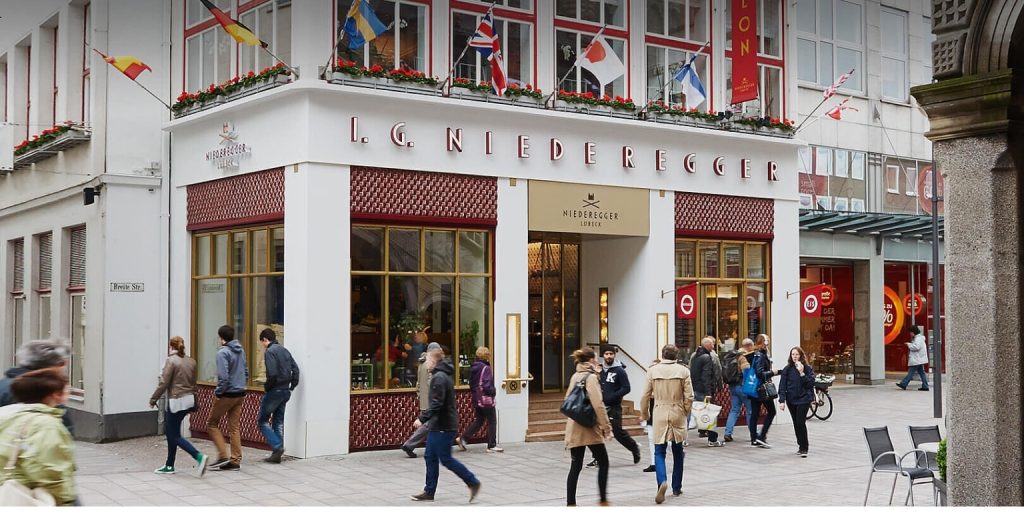
The Niederegger Marzipan Museum is a small exhibition on the second floor of Café Niederegger, the famous marzipan shop and café on Breite Straße, directly opposite Lübeck's Town Hall. Its star attraction is a group of twelve life-size figures made of marzipan, among them the Lübeck-born writer Thomas Mann. The rest of the room tells how almonds and sugar came together and how Lübeck became Germany's marzipan city.
Niederegger Marzipan Museum at a glance
- Where: on the second floor of Café Niederegger, Breite Straße 89, facing the Town Hall in the middle of Lübeck's old town island.
- Founded: the Niederegger firm dates from 1806, and Johann Georg Niederegger opened his own confectionery opposite the Town Hall in 1822.
- By: the Niederegger company, which still makes its marzipan in Lübeck.
- What it is today: a compact museum above a working café and shop, open during the café's opening times.
- Time needed: 15–20 minutes for the museum, longer if you stop for cake downstairs.
How Lübeck became the marzipan city
Marzipan reached northern Europe from the Mediterranean in the Middle Ages, and it is first mentioned in Lübeck's guild records in 1530. Almonds do not grow anywhere near the Baltic, but as the leading city of the Hanseatic League, Lübeck could import them, and from around 1800 its marzipan became known for its high almond content. In 1786 the confectioner Johann Gerhard Maret opened a café on the market square; his journeyman, Johann Georg Niederegger from Ulm, ran the business on his own account from 1806.
In 1822, when Maret's son took over the family café, Niederegger set up his own confectionery across from the Town Hall. Over the following decades around a dozen marzipan makers were founded in Lübeck, laying the ground for the city's worldwide reputation. Since 1996 'Lübecker Marzipan' has been a protected geographical indication in the European Union: only marzipan from Lübeck and the neighbouring towns of Bad Schwartau and Stockelsdorf may carry the name.
What to look for
- The twelve life-size marzipan figures, each modelled in almond paste, including Thomas Mann and the 17th-century writer Grimmelshausen.
- The panel on the original Niederegger recipe of 1806, the starting point of the company's story.
- The 'Almond Column' and the 'Sugar Column', which trace the long journeys of the two ingredients to the Baltic.
- The short film on how Niederegger marzipan is made today, from almonds to finished loaves.
- Downstairs, the shop counters with marzipan shaped as fruit, pigs and loaves, a living display of the craft you have just read about.
The famine legend
A popular story claims that marzipan was invented in Lübeck during a famine in 1407, when the town's bakers ran out of flour and made bread from almonds and sugar instead, and that the name comes from 'Marci panis', St Mark's bread. It is a legend: marzipan was made in the Middle East and southern Europe long before, and Lübeck's records only mention it more than a century later. The story is still told in the city, and you will see it repeated on souvenir boxes.
Tips for your visit
- Come in the morning on a weekday, when the stairs and the small museum room are quiet.
- Look up at the Town Hall from the café's windows: the view across Breite Straße takes in its dark glazed bricks and arcades.
- Try a marzipan cake or a slice of nut cake in the café, then buy marzipan in the shop on the ground floor on your way out.
- Combine the visit with the Town Hall and St Mary's Church, both less than a minute away.
Nearby
- Town Hall: directly opposite, one of Germany's oldest town halls still in use, with Gothic show walls and a Renaissance staircase.
- St Mary's Church: just behind the Town Hall, the mother church of brick Gothic, with the bells that crashed down in 1942 still lying where they fell.
- Holsten Gate: Lübeck's twin-towered city gate, a short walk west across the old town island.
- European Hansemuseum: at the northern end of the old town, telling the story of the Hanseatic League that made Lübeck rich.
See Lübeck with World City Trail
Our Lübeck scavenger hunt turns the old town into a game you play on your phone. The route links 10 stops and takes around 2 hours, with about 44 minutes of walking. It includes the Holsten Gate, the Town Hall across the street from Niederegger, and St Mary's Church.
If you prefer a different format, there is also a self-guided walking tour and an outdoor escape game in Lübeck.
Play the Lübeck scavenger hunt →
Take the self-guided walking tour of Lübeck →
Play the outdoor escape game in Lübeck →
Facts checked in October 2026.