
The Vienna Gate has been a vital point of entry to the Buda Castle District for centuries. Its name, “Vienna Gate,” is derived from its function as the starting point of the road that led to Vienna, the capital of the Habsburg Empire. The first gate on this site was likely built in the Middle Ages, serving as a defensive structure and a control point for goods and people entering the fortified city. The current gate, however, is not the original medieval structure. It was constructed much later, in the 20th century, as a monumental reconstruction that honored its historical predecessor.
The original medieval gate was part of the Castle Hill’s extensive fortification system, which was built to protect the royal palace, churches, and residential areas on the hill. This gate, along with others such as the Fehérvár Gate, controlled access and played a crucial role in the city’s defense during numerous sieges. Its location at the northern end of the district made it a strategic entry point, particularly for trade and communication with the west.
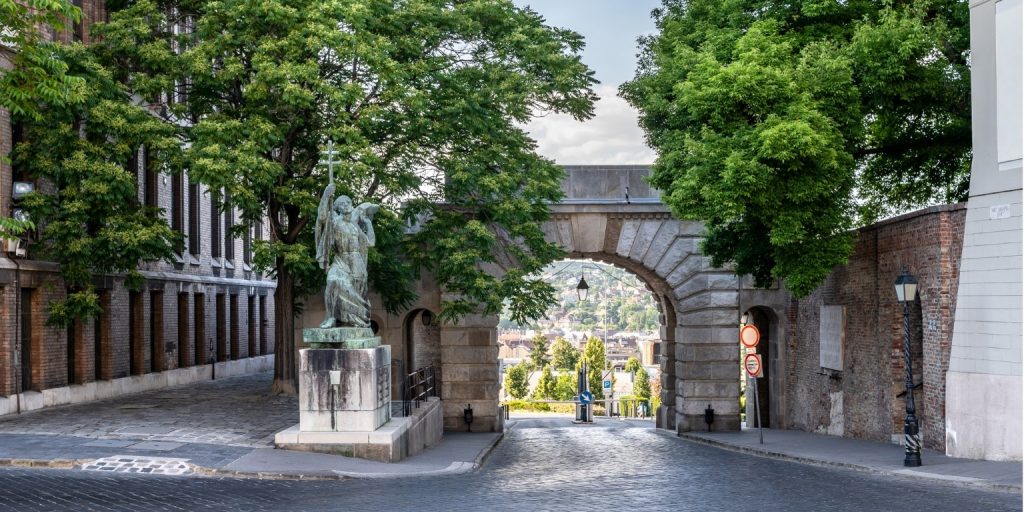
Architectural Reconstruction and Symbolism
The modern Vienna Gate was built in 1936 to commemorate the 250th anniversary of the recapture of Buda from Ottoman rule in 1686. The Habsburg forces, led by Charles of Lorraine, successfully reclaimed the city after a long siege, a pivotal moment in Hungarian history. The reconstruction of the gate was a project of great national pride and a symbolic act of reclaiming a part of the city’s heritage. The new gate was designed in a neo-Baroque style, a tribute to the period of its liberation, but it also incorporated modern elements.
It features a grand archway flanked by two large bastions, and its façade is adorned with the coats of arms of the counties of historical Hungary, a powerful symbol of national unity.
One of the gate’s most notable features is the relief sculpture on its facade, which depicts the liberation of Buda. This historical artwork, along with the coats of arms, turns the gate into a monumental work of public art that tells a story of triumph and resilience. The gate also stands as a testament to the Hungarian architectural and artistic skill of the 20th century, which sought to revive and honor the country’s historical past.

A Hub of the Buda Castle District
The Vienna Gate is not just a standalone monument; it is a central hub within the Buda Castle District. It provides easy access to some of the district’s most important sites. Inside the gate, you will find a tranquil square, also known as Bécsi kapu tér, which is surrounded by beautifully preserved historic buildings. The square is a great starting point for a walking tour of the district, which is a UNESCO World Heritage site.
From the gate, visitors can easily walk to the Buda Castle, Matthias Church, and Fisherman’s Bastion, each offering its own unique glimpse into Hungarian history and architecture. The gate’s elevated position also offers spectacular views of the surrounding area, including the sprawling residential areas of Buda and the hills beyond. Its presence marks a clear transition from the bustling streets below to the quiet, cobblestoned lanes of the historic district.
In essence, the Vienna Gate is a microcosm of Budapest’s history. It is a symbol of military struggle, a marker of national identity, and a functional piece of urban architecture. Its blend of medieval legacy and 20th-century reconstruction makes it a fascinating point of interest that invites visitors to pause and reflect on the city’s long and complex journey.
Further reading on Wikipedia: Vienna Gate