
The Schokoladenmuseum is Cologne's chocolate museum, a glass and metal building shaped like a ship's bow on the Rheinauhafen peninsula, just south of the old town. It tells the story of chocolate from the Olmecs, Maya and Aztecs to modern factories, and with around 650,000 visitors a year it is among the most visited museums in Germany.
The Chocolate Museum at a glance
- Where: on the Rheinauhafen peninsula in Altstadt-Süd, by the Rhine, a riverside walk south of the Fischmarkt.
- Opened: 31 October 1993.
- By: founded by the Cologne chocolate manufacturer Hans Imhoff; the building is by the architect Fritz Eller.
- What it is today: a privately run museum that receives no public subsidy, with Lindt & Sprüngli as its partner since 2006.
- Time needed: about two hours.
From a factory archive to a museum
Hans Imhoff owned most of Stollwerck, one of the historic chocolate makers of Cologne, from 1972. When the company moved to a new site in Cologne-Westhoven in 1975, he noticed how many old machines, moulds and documents it had and came up with the idea of a museum to keep them. Many people doubted it, so in 1989, for Stollwerck's 150th anniversary, he tested the idea with an exhibition in the Gürzenich hall, complete with a chocolate fountain. Within six weeks it drew more than five times the visitors he had hoped for.
Imhoff bought part of the old Rheinau harbour, including a Prussian customs building of 1898, the Malakoff Tower and a swing bridge, and added a new building whose shape recalls a ship. It was the first new building in what is now the Rheinauhafen district, and the museum opened in 1993. After Imhoff sold Stollwerck in 2002, Lindt & Sprüngli became the museum's partner in 2006, and the museum is now simply called the Schokoladenmuseum Köln.
What to look for
- The tropical house, a glass cube where cacao trees grow, so you can see the pods on the branch.
- The miniature production line that makes small chocolate bars in front of you.
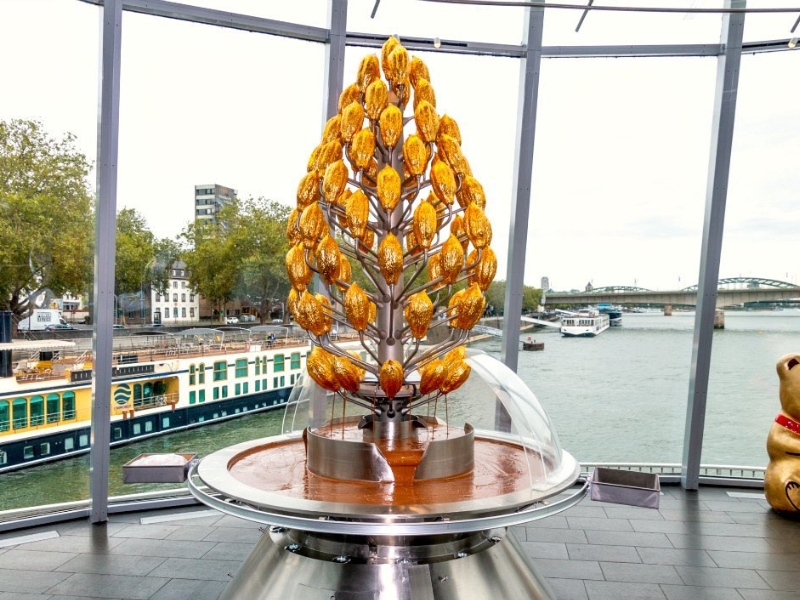
- The chocolate fountain, about three metres high, where staff dip wafers for visitors.
- Porcelain and silver cups and pots used for drinking chocolate in the 18th and 19th centuries.
- Old chocolate vending machines, historical moulds and the pre-Columbian section on cacao in Mesoamerica.
The building as a ship
Look at the museum from the riverside path: the new building points into the Rhine like the bow of a ship, while the brick customs building of 1898 sits behind it. From the terrace at the end of the visit you look back over the river to the old town, Great St. Martin, the cathedral and the Hohenzollern Bridge, one of the better free views in Cologne.
Tips for your visit
- Go early on weekdays; weekends and school holidays bring long queues and busy rooms.
- Leave the fountain until you have seen the history rooms, so you are not rushing through on a sugar high.
- Walk there along the Rhine from the old town; the riverside path passes the Malakoff Tower and the swing bridge.
Nearby
- Malakoff Tower and swing bridge: 19th-century harbour structures at the museum's entrance.
- Kranhäuser: the three modern office and apartment buildings shaped like harbour cranes, a short walk south along the Rheinauhafen.
- St. Maria Lyskirchen: a Romanesque church near the river, on the way back towards the old town.
- Fischmarkt and Great St. Martin: the colourful old fish market square and its Romanesque church, a riverside walk north.
See Cologne with World City Trail
Our Cologne scavenger hunt turns the old town into a game you play on your phone. The route links 10 stops and takes around 2 hours, with about 20 minutes of walking. The route includes Cologne Cathedral, the Fischmarkt, Great St. Martin Church and the Pegelturm on the Rhine. You can play in English, German, French, Italian, Spanish or Dutch.
If you prefer a different format, there is also a self-guided walking tour and an outdoor escape game in Cologne.
Play the Cologne scavenger hunt →
Take the self-guided walking tour of Cologne →
Play the outdoor escape game in Cologne →
Facts checked in October 2026.