
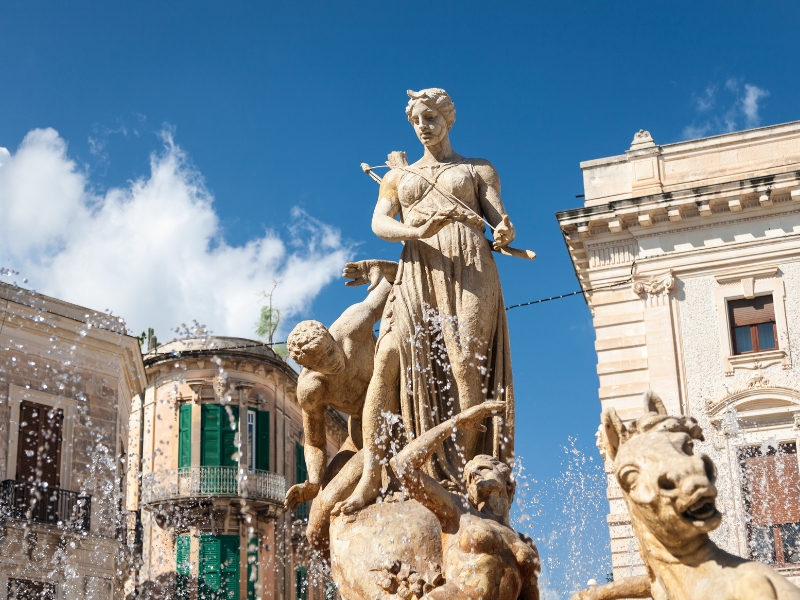
Syracuse, Siracusa in Italian, was once one of the most powerful cities of the Greek world, a rival to Athens and Carthage. Today its ancient heart is Ortigia, a small island of limestone streets where a cathedral stands inside a Greek temple and a freshwater spring rises a few steps from the sea. Here are the facts and stories that make the city special.
10 fun facts about Syracuse
- Founded by Corinthians: Syracuse was founded in the 8th century BC, traditionally in 734 BC, by settlers from Corinth who landed on the island of Ortigia.
- Praised by Cicero: the Roman orator Cicero called Syracuse the greatest of the Greek cities and the most beautiful of them all.
- A cathedral inside a temple: the Cathedral of Syracuse was built into a Doric temple of Athena from the 5th century BC. Its ancient columns are still visible in the walls, inside and out.
- One of the oldest Doric temples in Sicily: the Temple of Apollo in Ortigia dates from the early 6th century BC. Over the centuries it was a church, a mosque, a church again and part of a Spanish barracks.
- The home town of Archimedes: the great mathematician and inventor was born in Syracuse around 287 BC and died here in 212 BC, when Roman troops took the city.
- An ear named by a painter: the Ear of Dionysius, an artificial cave about 23 metres high in an ancient quarry, got its name from Caravaggio in 1608. Legend says the tyrant Dionysius used its echo to overhear his prisoners.
- A theatre still in use: the Greek Theatre in the Neapolis Archaeological Park is one of the largest of the Greek world. Since 1914 ancient tragedies and comedies have been staged there almost every year.
- A Caravaggio for the city's saint: Saint Lucy, patron saint of Syracuse, was martyred here according to tradition in 304. In 1608 Caravaggio painted the Burial of Saint Lucy for the church built over her burial place.
- Plato's failed experiment: the philosopher Plato travelled to Syracuse several times in the 4th century BC, hoping to turn its rulers into philosopher kings. It did not go well, and he barely escaped.
- Wild papyrus: papyrus grows in the Fountain of Arethusa and along the nearby river Ciane, one of the few places in Europe where it grows wild.
Archimedes and the siege of Syracuse
In 214 BC a Roman army and fleet under Marcus Claudius Marcellus attacked Syracuse, which had sided with Carthage. The city held out for about two years, largely thanks to Archimedes. Ancient writers describe his catapults and a giant claw that lifted Roman ships out of the water and dropped them. A later legend adds that he set the fleet on fire with mirrors, though historians doubt it. In 212 BC the Romans finally entered the city. According to the story, Archimedes was drawing circles in the sand when a soldier came in, and he told him not to disturb them. The soldier killed him, against Marcellus's orders. Today the city honours him with a bronze monument.
Ortigia, explained
Ortigia is the small island at the heart of Syracuse, joined to the mainland by bridges. The Greeks built their first settlement here, and almost every era has left its mark since: Greek temples, Norman and Swabian walls, and Baroque churches rebuilt after the great earthquake of 1693. On the western shore is the Fountain of Arethusa. Legend says that the nymph Arethusa fled from the river god Alpheus in Greece, and the goddess Artemis turned her into a spring that flowed under the sea and rose again here. Alpheus followed her below the waves, so the story goes, and their waters still mix.
What to eat in Syracuse
- Granita with brioche: crushed ice made with almonds, lemon, coffee or mulberries, eaten for breakfast in summer with a soft brioche bun.
- Arancini: fried rice balls with a filling of ragù or ham and cheese. In eastern Sicily they are often cone-shaped and called by the masculine name, arancino.
- Pachino tomatoes: small, sweet tomatoes from Pachino, south of Syracuse, protected by an EU geographical indication.
- Nero d'Avola: Sicily's best-known red grape, named after the town of Avola, a short drive down the coast.
- Cannoli: crisp fried pastry tubes filled with sweet ricotta, best when filled to order.
Good to know before you go
- Visit the Neapolis Archaeological Park early in the day: there is very little shade among the ruins.
- If you want to see a play in the Greek Theatre, look at the programme early. The season runs in late spring and early summer, and good seats go fast.
- Go to the morning street market in Ortigia, near the Temple of Apollo, for fish, fruit, cheese and street food.
- For a day trip, visit Noto, a Baroque town rebuilt after the 1693 earthquake and part of the UNESCO-listed Late Baroque Towns of the Val di Noto.
Explore Syracuse with World City Trail
Our Syracuse scavenger hunt turns these sights into a game you play on your phone. The route links 10 stops and takes around two hours, with about 36 minutes of walking, and includes the church of San Tommaso al Pantheon, the Foro Siracusano, the Archimedes monument and the island of Ortigia.
At each stop you solve a puzzle and hear a short story, at your own pace. You can start whenever you like.
Play the Syracuse scavenger hunt →
Facts checked in October 2026.