
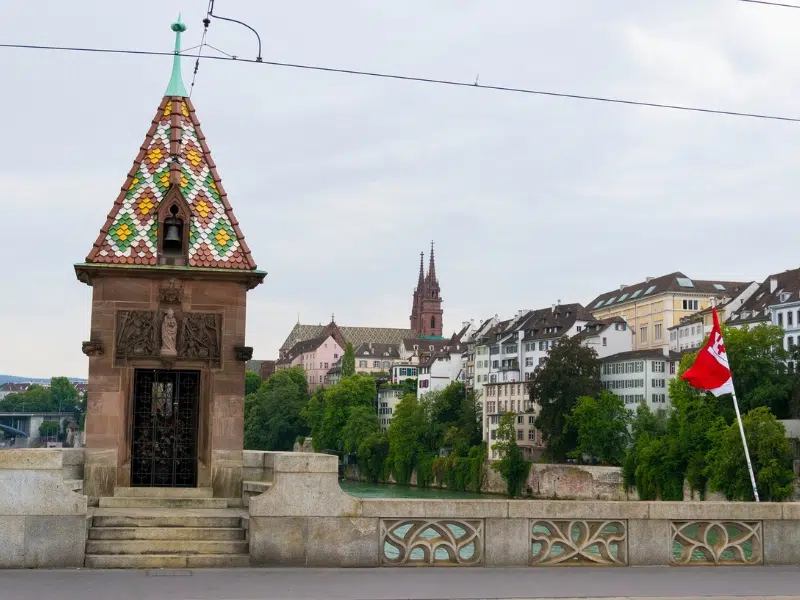
The Mittlere Brücke (Middle Bridge) links Grossbasel and Kleinbasel across the Rhine and stands on the oldest bridge site on the river between Lake Constance and the North Sea. The first bridge here was built in the early 13th century; today's stone bridge dates from 1905. In the middle stands the Käppelijoch, a small chapel where, until 1634, condemned offenders were drowned in the river.
The Mittlere Brücke at a glance
- Where: between the Schifflände in Grossbasel and Greifengasse in Kleinbasel, in the middle of the old town.
- Built: the first bridge in the 1220s; the present stone bridge in 1903–1905, opened on 11 November 1905.
- By: stonework designed by the Basel architect Emil Faesch, with the structure by Friedrich von Thiersch of Munich.
- What it is today: a 192-metre granite bridge with seven arches, closed to private cars since 2015 and used by trams, cyclists and pedestrians.
- Time needed: 15 to 20 minutes to cross, look at the chapel and find the sculptures at both ends.
From a bishop's loan to a granite bridge
Basel's first Rhine bridge was the project of Bishop Heinrich von Thun. A document of 1223 records that he pledged the cathedral treasury to a Jewish moneylender to raise funds for it, and in 1225 two monasteries were exempted from the bridge toll in return for their contributions. For centuries this was the city's only crossing and the lowest fixed bridge on the Rhine, and it changed Basel: on the far bank the settlements grew into the fortified town of Kleinbasel, which joined Grossbasel in 1392.
The medieval bridge, partly of stone and partly of wood, survived with many repairs until the early 20th century. Between 1903 and 1905 it was replaced by the present granite bridge, while a temporary wooden bridge kept traffic moving a few metres away. The name Mittlere Rheinbrücke was chosen because by then it was the middle one of three Basel bridges. The bridge was refurbished in 2002 without changes to its appearance, and since 2015 it has been part of the car-free city centre.
What to look for
- The Käppelijoch: the little chapel over the central pier, a faithful replica of the 15th-century stone chapel, with a relief of Bishop Heinrich von Thun above the entrance; its grille is often covered in padlocks left by couples.
- The granite itself, brought from the north side of the Gotthard massif, and the seven arches, one of which spans the riverside path in Kleinbasel.
- Helvetia auf der Reise at the Kleinbasel end: Bettina Eichin's bronze of Helvetia stepping off the Swiss coin, resting on the wall with her suitcase and looking up the Rhine.
- The Amazone at the Grossbasel end: Carl Burckhardt's last work, a striding Amazon leading a horse, cast after his death in 1923.
- Lagerstätte by the first pier on the Kleinbasel side: three figures from Kleinbasel's traditions, the Vogel Gryff, the Wild Maa and the Leu, lying together and often half covered by the river.
The Lällekönig
At the Grossbasel end of the bridge, look up at the corner of the building by the Schifflände for the Lällekönig, a crowned head that sticks out its tongue and rolls its eyes towards Kleinbasel. The original was part of a clock on the Rhine gate tower of the old bridge, which was demolished in the 19th century; the face you see today is a copy. Locals read it as Grossbasel's cheeky greeting to the other bank, a symbol of the long, friendly rivalry between the two halves of the city.
Tips for your visit
- Walk across in both directions: the view upstream towards the Minster is best from the bridge's centre, near the chapel.
- In summer, watch people swimming down the Rhine with their waterproof bags; the bridge is a good place to see Basel's favourite pastime.
- Watch for trams: the bridge is car-free but trams run across it, so stay on the pavements.
Nearby
- Basel Minster: the red sandstone cathedral above the Rhine, with views from the Pfalz terrace, a short walk upstream.
- Marktplatz and the Rathaus: the main square with the bright red town hall, a few minutes' walk from the Grossbasel end.
- The Rhine ferries: small boats without engines that cross the river on a cable, pushed only by the current.
See Basel with World City Trail
Our Basel scavenger hunt turns the old town into a game you play on your phone. The route links 10 stops and takes around three hours, with about 44 minutes of walking. It includes places such as the Strassburger Denkmal, the Offene Kirche Elisabethen and Basel Minster. You can play in English, German, French, Italian, Spanish or Chinese.
If you prefer a different format, Basel also has a self-guided walking tour and an outdoor escape game.
Play the Basel scavenger hunt →
Take the self-guided walking tour of Basel →
Play the outdoor escape game in Basel →
Facts checked in October 2026.