
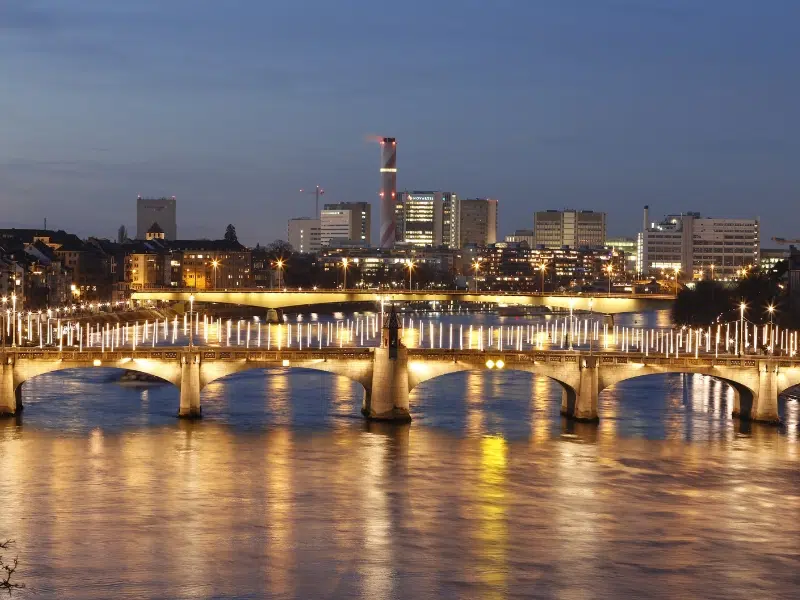
The Rhine runs straight through Basel, with the old town of Grossbasel on the left bank and Kleinbasel on the right. Right here the river makes a sharp bend, the Rhine knee, and turns north towards the North Sea. What makes it special is how the city uses it: four wooden ferries cross it without an engine, and on summer afternoons people swim down it with their clothes packed in a waterproof bag.
The Rhine in Basel at a glance
- Where: through the middle of Basel, between Grossbasel (the old town around the Minster) and Kleinbasel on the opposite bank.
- Oldest crossing: the Mittlere Brücke, first opened in 1226 and rebuilt as today's stone bridge in 1905.
- What it is today: a working river with cargo ships heading to and from the Swiss Rhine ports, four traditional ferries, two wooden river baths and long promenades on both banks.
- Where three countries meet: the borders of Switzerland, France and Germany meet in the middle of the river, on the northern edge of the city.
- Time needed: an hour for a ferry crossing and a walk along the Kleinbasel bank; half a day in summer if you want to swim.
One bridge, then many
For centuries Basel had just one bridge. The Mittlere Brücke opened in 1226 and is one of the oldest crossings of the Rhine between Lake Constance and the North Sea. At first it served local traffic between Grossbasel and Kleinbasel, which grew up on the right bank, but from the 14th century it became an important link in the trade route over the Gotthard Pass. In 1905 the old bridge was replaced by the present one, built to carry electric trams.
Until 1879 the Mittlere Brücke remained the only bridge, so ferries carried much of the traffic. The early ferries, known as 'flying bridges', were run by a society of artists, which used the profits to build the Kunsthalle on the Steinenberg. More bridges followed: the Wettstein Bridge in 1879, the Johanniter Bridge in 1882 and the Dreirosen Bridge in 1934. Cars and bridges took the ferries' trade away, and the last professional ferryman retired in 1976, but the four boats kept running thanks to a foundation and today's Fähri association.
What to look for
- The four ferries: Wilde Maa at St. Alban, Leu below the Minster, Vogel Gryff at Klingental and Ueli at St. Johann. They are named after figures from Kleinbasel tradition.
- How a ferry crosses: look for the cable stretched high across the river. The boat hangs from it on a line with a pulley, and the ferryman angles it so the current pushes it to the other side, with no engine at all.
- The Käppelijoch: the small chapel in the middle of the Mittlere Brücke, a copy of the old bridge chapel. In the Middle Ages death sentences were carried out here.
- The river baths: Rheinbad Breite and Rheinbad St. Johann are wooden bathing houses built over the water, with steps straight into the Rhine.
- Swimmers with fish: in summer you will see people floating downstream on the Kleinbasel side, each holding a colourful fish-shaped bag, the Wickelfisch.
Swimming in the Rhine
Swimming in the Rhine is a summer habit in Basel. People walk upstream along the Kleinbasel bank, pack their clothes into a Wickelfisch, a waterproof fish-shaped bag invented in Basel, and let the current carry them back down. The usual starting point is just below the Museum Tinguely, and most get out before the Dreirosen Bridge. The city's advice is clear: swim only if you are a strong swimmer, never alone and only when the water is warm enough; stay close to the Kleinbasel bank, keep away from bridge pillars, never jump off bridges and keep an eye upstream, because ships are quiet and cannot swerve.
Tips for your visit
- Take the Leu ferry below the Minster for the classic crossing: a few quiet minutes on the water with the cathedral above you.
- Walk the Kleinbasel bank in the late afternoon. It faces the old town and gets the evening sun, and it fills with people sitting on the steps by the water.
- For the best view of the bend, stand on the Pfalz, the terrace behind the Minster, and look across the river to Kleinbasel.
Nearby
- Basel Minster: the red sandstone cathedral on the hill above the river, with the Pfalz terrace behind it.
- Mittlere Brücke: walk across the oldest bridge to see the Käppelijoch and the views upstream and downstream.
- Museum Tinguely: a museum on the Kleinbasel bank devoted to Jean Tinguely's moving machine sculptures, in a building by Mario Botta.
- Dreiländereck: the monument at the Rhine port on the northern edge of the city, about 150 metres from the point in the river where Switzerland, France and Germany meet.
See Basel with World City Trail
Our Basel scavenger hunt turns the old town into a game you play on your phone. The route links 10 stops and takes around 3 hours, with about 44 minutes of walking. It includes the Strassburger Denkmal, the Offene Kirche Elisabethen and Basel Minster, high above the river. You can play in English, German, French, Italian, Spanish and Chinese.
If you prefer a different format, there is also a self-guided walking tour and an outdoor escape game in Basel.
Play the Basel scavenger hunt →
Take the self-guided walking tour of Basel →
Play the outdoor escape game in Basel →
Facts checked in October 2026.