
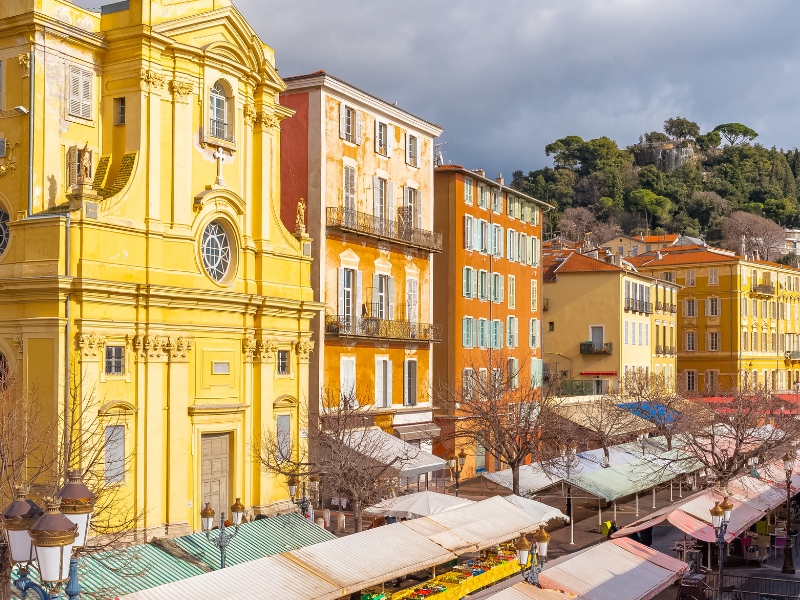
Cours Saleya is the long market square of Vieux Nice, the old town, running parallel to the sea just behind the Quai des États-Unis. In the morning it fills with flower and produce stalls, on Mondays with antiques, and in the evening with restaurant tables. At its eastern end stands the yellow building where Henri Matisse lived and painted for almost two decades.
Cours Saleya at a glance
- Where: in Vieux Nice, between the Préfecture palace and Place Charles-Félix, separated from the seafront by the low buildings of Les Ponchettes.
- Created: on land that was part of the old port area until the Middle Ages; the market layout dates from 1861.
- What it is today: a pedestrian square with a flower and food market most mornings, an antiques and flea market on Mondays, and café and restaurant terraces.
- Time needed: 30–60 minutes in the morning for the market, longer if you stay for lunch.
From harbour edge to market square
Until the 13th century this strip of land was an extension of the old Saint-Lambert port, later called Les Ponchettes. In the mid-16th century Duke Emmanuel Philibert of Savoy built a palace at its western end, which later housed the rulers of the Kingdom of Sardinia when they visited and today is the Préfecture of the Alpes-Maritimes. In 1776 the flat roofs of the low warehouses between the square and the sea were turned into a raised promenade, and the street became a place to walk and be seen.
In 1861, the year after Nice became French, Mayor Malausséna decided how the market should be laid out: flowers on the western side, fruit and vegetables on the eastern side, a division you can still see. In the second half of the 19th century the floats of the Nice Carnival paraded here, before the carnival moved to the Promenade des Anglais and Place Masséna. In the 20th century galleries in the old warehouses attracted painters such as Matisse, Bonnard, Chagall, Cocteau and Dufy.
What to look for
- The flower stalls on the western half, with cut flowers and potted plants from the region.
- The produce stalls on the eastern half, where you can try socca, the chickpea pancake that is a Nice speciality.
- The Chapelle de la Miséricorde, a Baroque chapel from 1740 on the square, with a richly decorated interior.
- The large yellow building at the eastern end, where Matisse lived and worked from 1921 to 1938, looking out over the market and the sea.
- The Préfecture palace at the western end, built for the Dukes of Savoy and closed to the public.
Matisse at the window
Matisse came to Nice in 1917 for the light and stayed for the rest of his life. For many of his years in the city his studio was in the building at the end of Cours Saleya, and windows opening onto the Mediterranean appear again and again in the paintings of that time. Later he moved up to the hill of Cimiez, where the Matisse Museum now stands and where he is buried. Standing on Place Charles-Félix and looking up at the shutters, it is easy to see what drew him here.
Tips for your visit
- Come in the morning: the market winds down around lunchtime, and the square turns into a terrace for diners.
- Visit on a Monday if you like antiques and second-hand finds rather than flowers.
- Climb the steps up to Les Ponchettes for a view down over the market roofs and out to sea.
- Watch your belongings in the crowd around the stalls, as in any busy market.
Nearby
- Castle Hill (Colline du Château): the park on the hill at the end of the old town, with a waterfall and the best views over the Baie des Anges.
- Promenade des Anglais: the seafront promenade, a minute away beyond Les Ponchettes.
- Place Rossetti and Sainte-Réparate Cathedral: the old town's busiest little square, with the Baroque cathedral and ice-cream shops.
- Opéra de Nice: the 19th-century opera house just west of the square, close to the sea.
See Nice with World City Trail
Our Nice scavenger hunt turns the city into a game you play on your phone. The route takes around two hours, with about 35 minutes of walking, and you solve puzzles and hear stories at your own pace.
If you prefer a different format, Nice also has a self-guided walking tour and an outdoor escape game.
Play the Nice scavenger hunt →
Take the self-guided walking tour of Nice →
Play the outdoor escape game in Nice →
Facts checked in October 2026.