
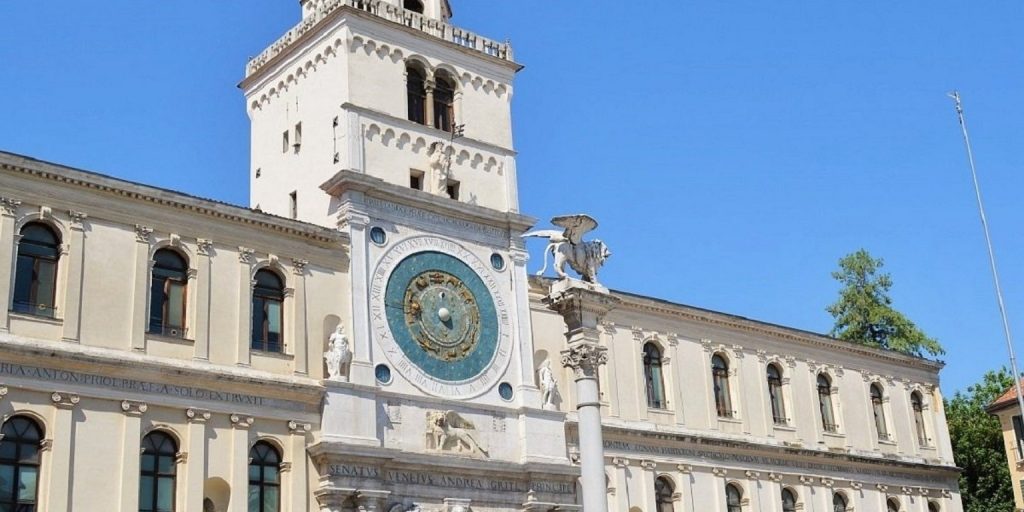
The Torre dell'Orologio is the clock tower on Piazza dei Signori in Padua, and its great dial is one of the oldest astronomical clocks in Italy. Rebuilt in the 1430s from a design of 1344, it shows the hours, the Moon and the Sun's path through the zodiac, with one sign famously missing: Libra.
The Torre dell'Orologio at a glance
- Where: on Piazza dei Signori, between the Palazzo del Capitanio and the Palazzo dei Camerlenghi.
- Built: the tower in the late 1420s; the present clock from 1427, finished in 1434 and installed in 1437.
- By: Matteo Novello and Giovanni and Giampietro dalle Caldiere, faithfully copying the clock designed by Jacopo Dondi in 1344.
- What it is today: a working astronomical clock about 30 metres above the square, restored and set going again in 2010.
- Time needed: 10–15 minutes to read the dial from the square; longer if you join a guided visit inside the tower.
Two clocks and a family name
The first astronomical clock in Padua was built in 1344 by Jacopo Dondi, a physician from Chioggia, for Ubertino da Carrara, lord of the city. The clock made Jacopo's name, literally: his family became known as the Dondi dall'Orologio, 'Dondi of the Clock'. His son Giovanni went on to build the astrarium, a famous planetary clock. Jacopo's original was destroyed at the end of the 14th century, when Carrara rule in Padua collapsed.
Under Venetian rule the city built a new tower on Piazza dei Signori and, from 1427, a new clock that reproduced Dondi's design. The clockmakers Matteo Novello and Giovanni and Giampietro dalle Caldiere finished it in 1434, and it was put in place in 1437. Around 1531 the architect Giovanni Maria Falconetto added the grand triumphal arch at the base of the tower. The mechanism was restored by the A.R.A.S.S.-Brera association, and the clock and its bell returned to the square in 2010.
What to look for
- The 24-hour dial: the outer ring counts all 24 hours of the day in Roman numerals, so the single hand goes round only once a day.
- The Sun on the hand: the hour hand carries a small sun, which moves through the zodiac over the year and shows the season.
- The zodiac: the signs are reliefs in gilded copper. Count them and you will find only eleven, because Libra is not there.
- The Moon window: a round opening shows the phase of the Moon, and gilded copper stars are set on the dial.
- Falconetto's arch: the Renaissance gateway at the foot of the tower, from around 1531. Walk through it into the courtyard of Piazza del Capitaniato behind.
Why is Libra missing?
Legends offer two answers. One says the clockmaker left Libra out because he was never paid the agreed sum. Another says it was a protest against the city's rulers. The likelier explanation is astronomical: in older tradition Libra was not a separate sign, and its stars were read as the claws of the Scorpion. The names of Libra's two brightest stars still mean 'northern claw' and 'southern claw' in Arabic.
Tips for your visit
- Stand in the middle of Piazza dei Signori, facing the tower, for the clearest view of the dial; mid-morning light works well for photos.
- Wait for the top of the hour to hear the bell strike.
- Guided visits inside the tower, up to the mechanism, run on some days; check locally before you go.
Nearby
- Palazzo della Ragione: the medieval town hall with its huge upper hall, the Salone, a few minutes' walk away between the two market squares.
- Piazza delle Erbe and Piazza della Frutta: the market squares on either side of the Palazzo della Ragione, busiest in the morning.
- Loggia del Consiglio: the elegant Renaissance loggia on the same square, a few steps from the clock.
- Padua Cathedral and Baptistery: a short walk away, where the baptistery is covered with 14th-century frescoes by Giusto de' Menabuoi.
See Padua with World City Trail
Our Padua scavenger hunt turns the old town into a game you play on your phone. The route links 10 stops and takes around 2 hours, with about 42 minutes of walking. It includes the Scrovegni Chapel and Piazza Garibaldi.
If you prefer a different format, there is also a self-guided walking tour and an outdoor escape game in Padua.
Play the Padua scavenger hunt →
Take the self-guided walking tour of Padua →
Play the outdoor escape game in Padua →
Facts checked in October 2026.