
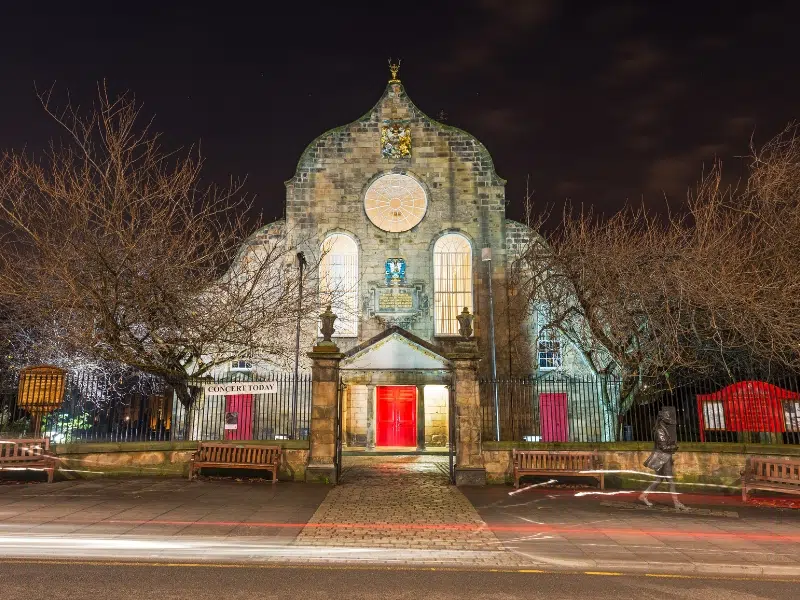
The Canongate is the lower part of Edinburgh's Royal Mile, running downhill from the site of the old Netherbow Port to the Palace of Holyroodhouse and the Scottish Parliament. For about seven centuries it was not part of Edinburgh at all but a separate burgh, founded by the abbey of Holyrood, and it only joined the city in 1856. Its name means 'the canons' way', the road the abbey's canons took up to the town.
The Canongate at a glance
- Where: the eastern stretch of the Royal Mile, from the junction with St Mary's Street and Jeffrey Street down to Abbey Strand and Holyroodhouse.
- Founded: as a burgh around 1143, under a charter of King David I to Holyrood Abbey, which he had founded in 1128.
- What it is today: a street of 16th- and 17th-century buildings, narrow closes and museums, with the modern Scottish Parliament at its foot.
- Time needed: about 30 minutes to walk down it, two hours or more with the museums and the kirkyard.
A burgh of its own
Holyrood Abbey was founded in 1128, and David I's charter of around 1143 allowed its canons to set up a burgh on the land between the abbey and Edinburgh. The abbey ruled the Canongate until the Scottish Reformation; the royal residence at Holyrood brought courtiers and nobles, who built town houses along the street. The abbey also offered sanctuary, and for centuries debtors could escape their creditors inside the Girth of Holyrood, whose western limit was marked by the Girth Cross at the foot of the street. Edinburgh bought the feudal superiority of the Canongate in 1636, but the burgh was only formally merged into the city in 1856.
The burgh had its own council, courthouse and jail in the Canongate Tolbooth, built in 1591. In 1688 King James VII turned the old parish church in the nave of Holyrood Abbey into a chapel for the Order of the Thistle, so a new parish church was needed: the Canongate Kirk, designed by James Smith and finished in 1691. In the 19th and 20th centuries many grand houses decayed into overcrowded tenements and breweries and industry moved in. The Scottish Parliament building, opened at the foot of the street in 2004, and new housing have since brought people back.
What to look for
- The Canongate Tolbooth: the turreted 1591 building with a clock projecting over the street. It now houses The People's Story, a museum of the everyday lives of Edinburgh's working people.
- Canongate Kirk's curved gable, topped by a gilded cross set between real stag's antlers. They were put up in 1949 and came from a stag shot by King George VI at Balmoral.
- The bronze statue of the poet Robert Fergusson by David Annand outside the kirk gate, striding down the hill with a book under his arm. It was unveiled in 2004.
- Canongate Kirkyard: the graves of the economist Adam Smith, the poet Robert Fergusson, whose headstone was paid for by Robert Burns, and Agnes Maclehose, the 'Clarinda' of Burns's love letters.
- Huntly House, the 16th-century building opposite the Tolbooth, now the Museum of Edinburgh.
- The pavement markers: a Maltese cross in the setts marks the site of St John's Cross, and a circle of setts near the foot of the street marks the Girth Cross.
The stag and the cross
A legend explains the Canongate's emblem, a stag's head with a cross between its antlers. King David I is said to have gone hunting on the feast of the Holy Rood, the Holy Cross, when he was thrown from his horse and attacked by a great stag. A cross appeared between its antlers, the stag fled, and the grateful king founded Holyrood Abbey on the spot. It is a legend, not history, but the stag and cross still appear on the burgh's old arms and on the gable of the Canongate Kirk.
Tips for your visit
- Walk it downhill, from the top of the Royal Mile towards Holyroodhouse: the street opens up as you go and ends at the palace gates.
- The Museum of Edinburgh and The People's Story stand opposite each other, so you can do both in one stop.
- Step into the closes: Dunbar's Close leads to a quiet walled garden laid out in 17th-century style, a good break from the crowds.
- Canongate Kirk is a working parish church and the kirkyard is a burial ground; keep your voice down and keep to the paths.
Nearby
- Palace of Holyroodhouse: the monarch's official residence in Scotland, with the ruins of Holyrood Abbey beside it, at the foot of the Canongate.
- Scottish Parliament: the building designed by the Catalan architect Enric Miralles, opened in 2004, opposite the palace.
- Holyrood Park and Arthur's Seat: the extinct volcano that rises right behind the palace, with paths up to the summit.
- John Knox House: the 15th- and 16th-century house at the top of the Canongate, linked with the reformer John Knox and now part of the Scottish Storytelling Centre.
See Edinburgh with World City Trail
Our Edinburgh scavenger hunt turns the city centre into a game you play on your phone. The route links 10 stops and takes around 3 hours, with about 56 minutes of walking. It includes places such as the Scott Monument and the Royal Scottish Academy. You can play in English, German, French, Italian, Spanish or Dutch.
If you prefer a different format, there is also a self-guided walking tour and an outdoor escape game in Edinburgh.
Play the Edinburgh scavenger hunt →
Take the self-guided walking tour of Edinburgh →
Play the outdoor escape game in Edinburgh →
Facts checked in October 2026.