
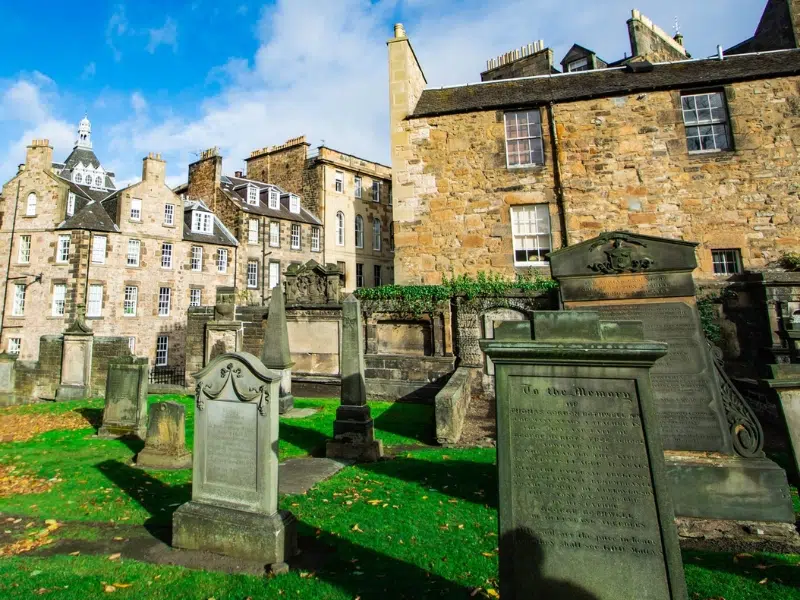
Greyfriars Kirkyard is the old graveyard around Greyfriars Kirk, on the southern edge of Edinburgh's Old Town, in use for burials since the 1560s. It is packed with carved 17th-century monuments, iron cages built against body snatchers and the graves of famous Scots, and it is where the National Covenant was signed in 1638. Most visitors, though, come for a small dog: Greyfriars Bobby, the Skye terrier said to have guarded his master's grave here for 14 years.
Greyfriars Kirkyard at a glance
- Where: off Candlemaker Row at the top of the Grassmarket, beside George Heriot's School, a few steps from the Bobby statue on George IV Bridge.
- Opened: 1562, on the grounds of a Franciscan friary dissolved two years earlier; Greyfriars Kirk itself opened in 1620.
- What it is today: a working kirkyard run by the City of Edinburgh Council with a charitable trust, protected as a Category A listed site.
- Time needed: 30–45 minutes to walk the paths and find the main monuments.
- Good to know: the gated south-west section, the Covenanters' Prison, is locked and can only be seen on guided visits.
From friary garden to Covenanters' prison
The name comes from the Franciscan friars, who wore grey habits and had a friary here until the Reformation of 1560. Two years later the town council made the friary's garden a new burial ground to replace the crowded kirkyard of St Giles'. In February 1638 Scottish Presbyterians gathered in Greyfriars Kirk to sign the National Covenant, a protest against the king's changes to their church, and the decades of conflict that followed made the Covenanters part of the place's story.
After the Covenanters were defeated at Bothwell Bridge in 1679, about 1,200 prisoners were brought to Edinburgh, and hundreds of them were held for months in an open field just south of the kirkyard. Part of that field later became an extension of the graveyard, lined with walled tombs, and it is still known as the Covenanters' Prison. In the 1840s the photographic pioneers David Octavius Hill and Robert Adamson used the kirkyard as an outdoor studio for some of their portraits.
What to look for
- The mortsafes: heavy iron cages over two graves, put there to stop the 'resurrection men' who stole bodies for Edinburgh's anatomy schools in the early 19th century.
- The 17th-century wall monuments along the old east and west walls, carved with skulls, hourglasses, angels and other symbols of death and resurrection.
- The domed tomb of Sir George Mackenzie, the lawyer known as 'Bloody Mackenzie' for prosecuting Covenanters, modelled on Bramante's Tempietto in Rome.
- The Martyrs' Monument, which remembers the Covenanters executed for their faith.
- Bobby's headstone near the gate, set up in 1981, and the grave of John Gray, the man he is said to have guarded, on the eastern path.
Greyfriars Bobby: story and legend
According to the story, Bobby was a Skye terrier who belonged to John Gray, a night watchman with the Edinburgh police. When Gray died in 1858 and was buried here, the dog stayed by his grave until his own death in 1872. Some details are disputed, and some historians think the story was helped along by people who fed the dog and the visitors he attracted. His bronze statue on the corner of George IV Bridge and Candlemaker Row dates from 1873. Visitors rub its nose for luck so often that the bronze has been worn shiny, and visitors are now asked not to. Visitors also leave sticks on Bobby's headstone.
Tips for your visit
- Come early in the morning or in the late afternoon, when the paths are quiet and the low light brings out the carvings.
- Walk to the far end of the kirkyard for one of the best views of Edinburgh Castle rising above the gravestones.
- Remember it is still a graveyard: keep to the paths, don't climb on monuments and be quiet near funerals or services.
- If you want to see the locked Covenanters' Prison, look for one of the guided evening tours that have access.
Nearby
- Greyfriars Bobby statue: just outside the gate, the small bronze dog that most people come to see.
- National Museum of Scotland: across Chambers Street, a few minutes' walk, with Scottish history from prehistory to Dolly the sheep.
- Grassmarket: the old market square below the Castle, lined with pubs, reached down Candlemaker Row.
- Victoria Street: the curving street of colourful shopfronts that climbs from the Grassmarket to the Royal Mile.
See Edinburgh with World City Trail
Our Edinburgh scavenger hunt turns the city centre into a game you play on your phone. The route links 10 stops and takes around 3 hours, with about 56 minutes of walking. It includes the Scott Monument and the Royal Scottish Academy. You can play in English, German, French, Italian, Spanish and Dutch.
If you prefer a different format, there is also a self-guided walking tour and an outdoor escape game in Edinburgh.
Play the Edinburgh scavenger hunt →
Take the self-guided walking tour of Edinburgh →
Play the outdoor escape game in Edinburgh →
Facts checked in October 2026.