
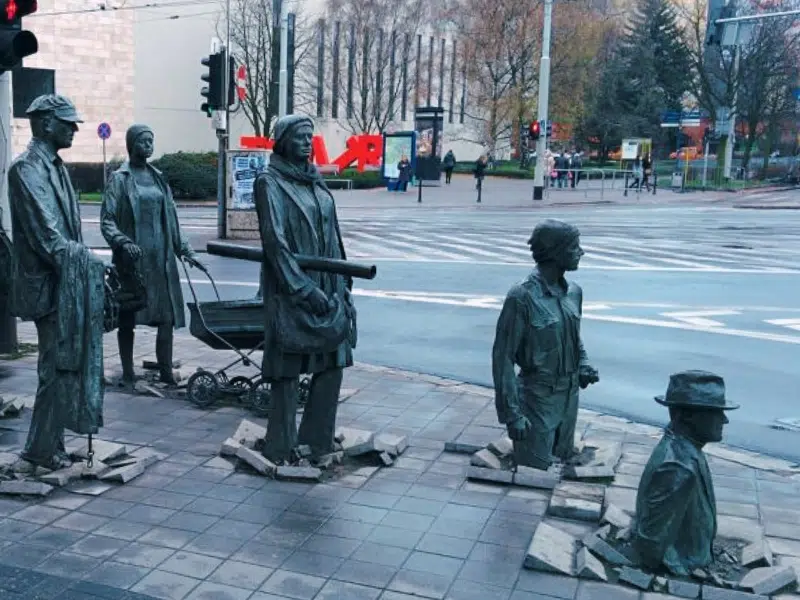
The Passage (Przejście) is a group of 14 life-size bronze figures on Świdnicka Street in Wrocław, where it crosses Piłsudskiego Street. On one side of the road seven people sink step by step into the pavement; on the other side seven come back up out of it. Most people know it as the Monument to the Anonymous Pedestrians, and it was unveiled in December 2005, at the anniversary of martial law in Poland.
The Passage at a glance
- Where: on both sides of ulica Świdnicka at its junction with ulica Piłsudskiego, south of the Old Town, on the way between the Market Square and the main railway station.
- Created: the bronze version was unveiled in December 2005; it is based on an installation the artist first showed in Warsaw in 1977.
- By: the Polish artist Jerzy Kalina.
- What it is today: an open-air sculpture on a busy street corner, free to see at any hour, and one of the best-known modern monuments in Poland.
- Time needed: 10–15 minutes, including crossing the street to see both groups.
From a Warsaw happening to a memorial of martial law
Jerzy Kalina made the first Passage in 1977 as a temporary installation for a television programme about contemporary art. It stood at the crossing of Świętokrzyska and Marszałkowska streets in Warsaw and was shown on the night of 12–13 December 1977. Those first figures were made of plaster and real clothes stiffened with paint, and they later spent decades in the collection of the National Museum in Wrocław.
In 2005 the city of Wrocław invited Kalina to make a permanent version in bronze. Its unveiling was tied to the anniversary of martial law, imposed on 13 December 1981 to crush the Solidarity movement and lifted in 1983, so the figures are now widely read as people forced underground by fear and arrests who later return to the surface. Kalina's original work came four years before martial law, though, so that meaning was added later. In 2025, twenty years after the unveiling, the city repaired the sculpture: a child had broken off a heavy bronze cane, and the wheels of a pram had been damaged.
What to look for
- The descent: follow the figures on the first side of the street as they sink lower with every step, until the last ones are half swallowed by the paving stones.
- The return: cross over and you see the same movement in reverse, as the figures climb back out of the ground.
- The 1970s clothes: coats, hats and bags in the style of the decade when Kalina first made the work.
- The props: look for a briefcase, a walking cane and a pram among the figures. The cane and the pram are the parts that were repaired in 2025.
- The scale: the figures are life-size and stand right on the pavement, so real pedestrians walk among them as if they were part of the crowd.
Fame beyond Wrocław
The Passage has travelled far as a photograph. Newsweek included it in a 2011 list of the 15 most beautiful places in Poland, the American magazine Budget Travel called it one of the most unusual places in the world, and in 2015 the architecture magazine Arch2O put it on a list of the 25 most creative monuments in the world.
Tips for your visit
- Come in the early morning or the evening, when the pavements are quieter, if you want photos without other people in the frame.
- See both sides: use the pedestrian crossing at the junction, because the idea only works when you see the descent and the return together.
- Please don't climb on the figures or hang on the props; the 2025 repairs were needed because of that kind of wear. Stand beside them for your photo instead.
- Walk north along Świdnicka afterwards: the street leads straight to the Market Square, past several of the sights below.
Nearby
- Renoma: the former Wertheim department store on Świdnicka, designed by Hermann Dernburg and opened in 1930, a short walk north and still a shopping centre today.
- Wrocław Opera: the 19th-century opera house on Świdnicka, designed by Carl Ferdinand Langhans, worth a look for its classical façade even if you are not seeing a show.
- St Dorothy's Church: a tall Gothic church founded in the 14th century, beside the Opera.
- Market Square (Rynek): the centre of the Old Town at the end of Świdnicka, with the Gothic Town Hall and many of the city's little bronze dwarfs.
See Wrocław with World City Trail
Our Wrocław scavenger hunt turns the old town into a game you play on your phone. The route links 10 stops and takes around 3 hours, with about 58 minutes of walking. The Passage sculptures are one of the stops, along with Copernicus Park. You can play in English, German, French, Italian, Spanish, Dutch or Polish.
If you prefer a different format, there is also a self-guided walking tour and an outdoor escape game in Wrocław.
Play the Wrocław scavenger hunt →
Take the self-guided walking tour of Wrocław →
Play the outdoor escape game in Wrocław →
Facts checked in October 2026.