
Nestled in the heart of Cambridge, England, The Eagle pub stands as far more than just a traditional watering hole. This historic establishment, with its roots stretching back centuries, is a living testament to some of the most pivotal moments in human history, intimately connected with groundbreaking scientific discoveries and the camaraderie of wartime heroes. Its warm, inviting atmosphere, coupled with its extraordinary past, makes The Eagle a quintessential stop for anyone exploring the intellectual and social fabric of Cambridge.
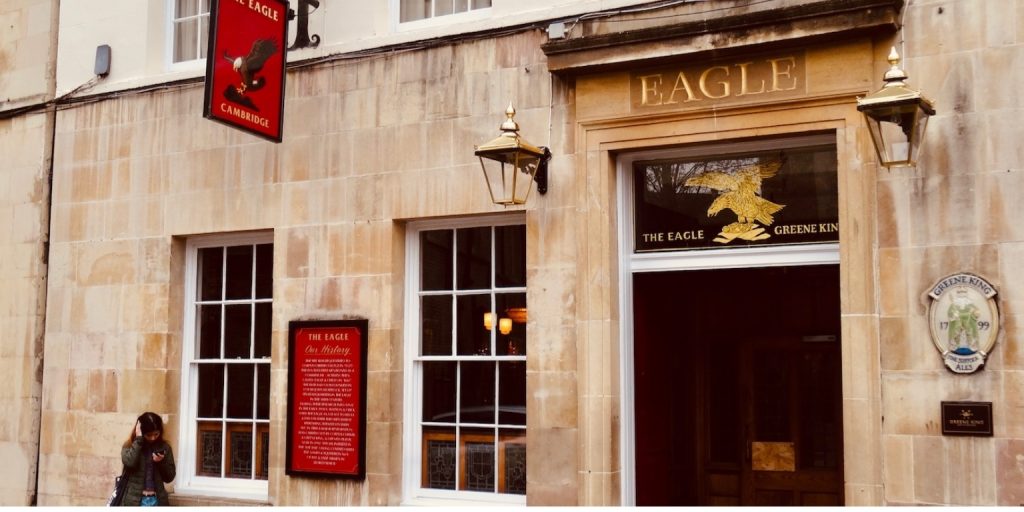
An Ancient Inn with Enduring Charm
The history of The Eagle dates back to the 17th century. The pub officially opened in 1667, making it one of Cambridge’s oldest public houses, second only to the Pickerel Inn. Originally known as the “Eagle and Child,” it began its life as a bustling coaching inn, catering to travelers journeying to and from London. Its strategic location in the city center, particularly near the old Cavendish Laboratory of Cambridge University, would later play a significant role in its fame.
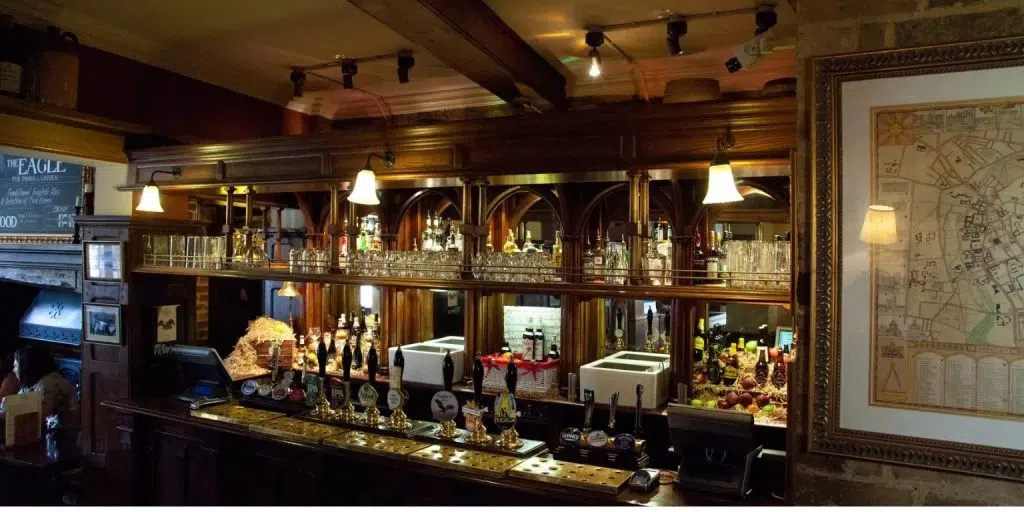
The pub’s architecture, with its circa 1600 street frontage on Bene’t Street and a charming galleried 19th-century wing overlooking a courtyard, reflects its long and varied history. Today, owned by Corpus Christi College and managed by Greene King brewery, The Eagle retains much of its original character, with dark wood paneling, cozy fireplaces, and a tangible sense of history permeating its various rooms.
The “Secret of Life”: A Scientific Breakthrough
Perhaps the most renowned chapter in The Eagle’s history is its indelible link to one of the 20th century’s greatest scientific discoveries. In the mid-20th century, the pub was a popular lunchtime haunt for scientists from the nearby Cavendish Laboratory, then located on Free School Lane. Among its regular patrons were two brilliant, albeit often eccentric, researchers: Francis Crick and James Watson.
On the momentous day of February 28, 1953, after they had formulated their revolutionary proposal for the double-helix structure of DNA (deoxyribonucleic acid), Crick reportedly burst into The Eagle, interrupting lunchtime conversations to announce that he and Watson had “discovered the secret of life.” This informal declaration in a public pub has become legendary, symbolizing the excitement and collaborative spirit of scientific inquiry that characterized Cambridge at the time. Their discovery, which elucidated how our genetic code is stored and replicated, laid the foundation for modern molecular biology and has had world-changing implications for medicine and genetics.
A blue plaque proudly adorns the pub’s exterior, commemorating this historic announcement. Inside, further plaques mark the very spot where Crick and Watson regularly lunched, allowing visitors to stand in the footsteps of scientific giants. The pub even offers a special ale, aptly named “Eagle’s DNA,” to commemorate this monumental breakthrough. It is important to note that their discovery relied heavily on the crucial X-ray diffraction data generated by Rosalind Franklin and Maurice Wilkins at King’s College London, a fact now increasingly acknowledged alongside Crick and Watson’s pivotal interpretative work.
The RAF Bar: A Wartime Time Capsule
Another profoundly significant and visually striking feature of The Eagle is its “RAF Bar.” During World War II, Cambridge was surrounded by numerous RAF airbases, and The Eagle became a favored off-duty haunt for Allied airmen, particularly pilots from the Royal Air Force.
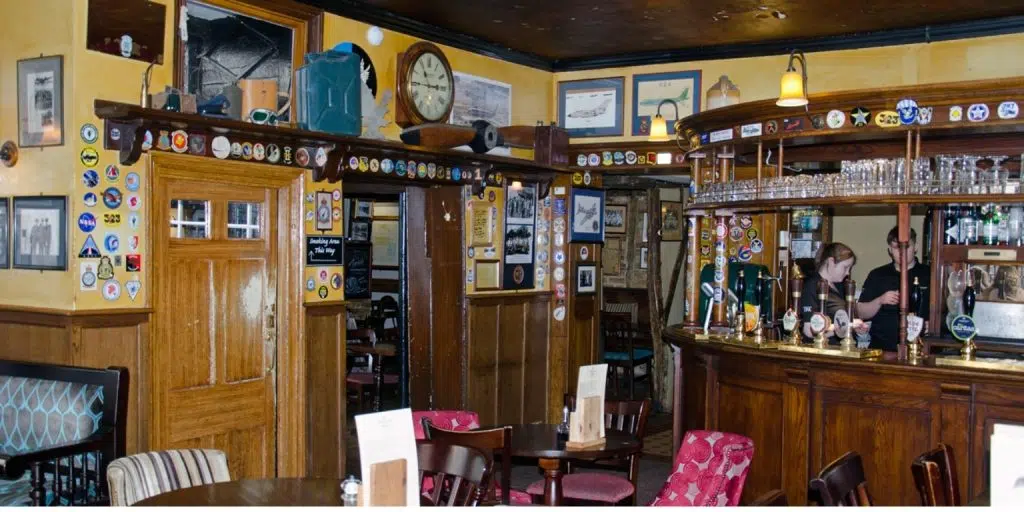
As a unique and poignant tradition, these airmen, using wax candles, petrol lighters, and even lipstick, burned or wrote their names, squadron numbers, and other doodles onto the ceiling of the rear bar. This impromptu graffiti, a testament to their camaraderie and a quiet defiance in the face of imminent danger, covered nearly every inch of the ceiling. In the early 1990s, former RAF Chief Technician James Chainey painstakingly cleaned, deciphered, and preserved these inscriptions, transforming the ceiling into a unique historical artifact. Today, the RAF Bar serves as a powerful and moving memorial to the bravery and sacrifice of those who served, with framed photographs and memorabilia adding to the evocative atmosphere.
The Eagle pub in Cambridge, established in 1667, is a rare blend of historical longevity, scientific significance, and wartime remembrance. It continues to draw a diverse crowd – from curious tourists eager to witness the “secret of life” and the RAF graffiti, to academics and locals seeking solace in its traditional ambiance. It stands as a cherished landmark, offering a tangible connection to the extraordinary stories that have unfolded within its ancient walls.