
In the heart of Leuven, a city celebrated for its historic university, vibrant student culture, and stunning Gothic architecture, stands a truly eye-catching and thought-provoking modern sculpture known simply as the “Totem”. This dramatic public artwork, a beacon for both locals and visitors, has become one of Leuven’s most recognizable contemporary landmarks. Far more than just a piece of metal, the Totem in Leuven is a playful yet profound symbol of knowledge, history, and the dynamic spirit of the city’s academic community.
A Striking Vision by Jan Fabre
The Totem sculpture was created by the renowned Belgian artist Jan Fabre, a multidisciplinary artist celebrated for his provocative and often controversial work across various mediums, including performance art, drawing, and sculpture. Fabre’s “Totem” was officially unveiled in 2004 and quickly became a talking point in Leuven, generating both admiration and debate—a hallmark of much of Fabre’s public art.
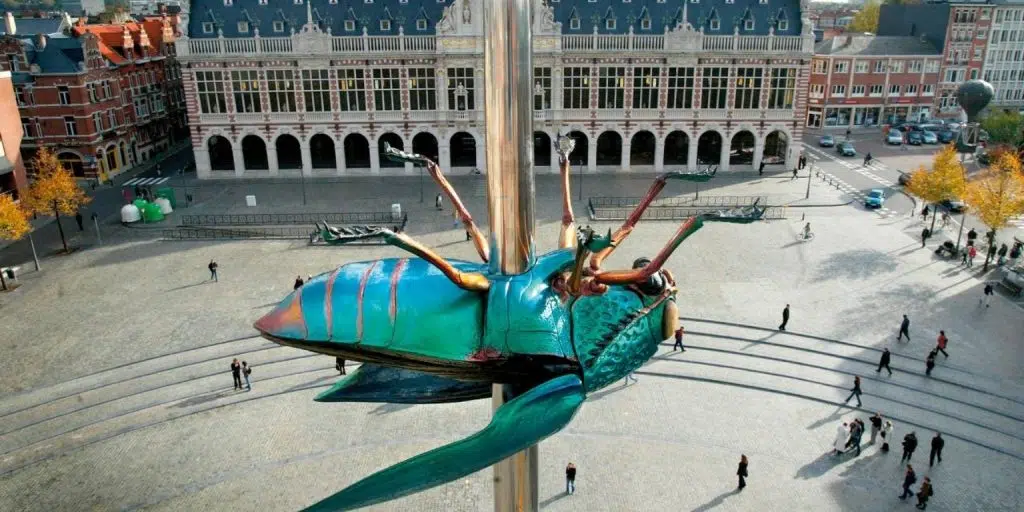
The sculpture’s design is truly unique: it features a gigantic green beetle, seemingly impaled on a needle, poised atop a towering obelisk. This striking image stands prominently in front of the University Library of the KU Leuven on Ladeuzeplein (Ladeuze Square), a fitting and highly symbolic location. The beetle, with its iridescent green carapace, immediately draws the eye, its sheer size creating a surreal and memorable impression against the backdrop of the grand library.

Symbolism: Knowledge, Transformation, and the Mundane
Like much of Fabre’s work, the Totem in Leuven is rich with symbolic meaning, inviting multiple interpretations:
- The Beetle: The choice of a beetle is significant for Fabre, who often uses insects in his art. Beetles, particularly scarab beetles, were revered in ancient cultures (like Egypt) as symbols of creation, rebirth, and the cycle of life. In Fabre’s context, they can also represent the mundane, the overlooked, and the fragile beauty of the natural world. The specific vibrant green color evokes life, growth, and perhaps even the preciousness of nature.
- The Obelisk and the Pin: The towering needle on which the beetle is impaled can be seen as a symbol of scientific inquiry, classification, and the relentless human quest for knowledge – akin to a zoologist pinning an insect for study. Placed directly in front of a vast library, a repository of knowledge, this interpretation gains considerable weight. It subtly questions the sometimes-invasive nature of scientific pursuit or the way knowledge can “pin down” and categorize life.
- A Modern Totem: The term “totem” itself suggests a sacred object or symbol representing a community or clan. In this urban context, Fabre’s “Totem” can be seen as a contemporary symbol for Leuven’s academic community, representing their pursuit of knowledge and the vibrant, often quirky, spirit of student life.
The sculpture challenges viewers to consider the relationship between art, science, nature, and urban spaces, sparking conversations that are perfectly aligned with a university city.

A Beloved (and Debated) Landmark
From its installation, the Totem in Leuven has been a magnet for attention. It quickly became a popular meeting point for students, a backdrop for countless selfies, and a landmark used by locals to give directions. Its controversial nature at the time of its unveiling – a giant bug on a spike! – has since mellowed into widespread acceptance and even affection. It’s a testament to the power of public art to become an integral part of a city’s identity.
The location on Ladeuzeplein is particularly impactful. This large, open square is a central hub for student activities and features the impressive University Library, a Flemish neo-Renaissance building with a rich history (rebuilt after World War I with American funding). The juxtaposition of the historic library, representing centuries of accumulated knowledge, with Fabre’s modern, thought-provoking sculpture creates a dynamic dialogue between past and present, tradition and innovation.
The Totem in Leuven, created by Jan Fabre in 2004 and located on Ladeuzeplein in front of the University Library, stands as a truly unique and compelling public artwork. Its striking imagery and rich symbolism – exploring themes of knowledge, nature, and the human condition – have cemented its place as one of Leuven’s most iconic and beloved contemporary landmarks, embodying the intellectual curiosity and vibrant spirit of this historic university city.