
The statue is a tribute to the legendary figure of Molly Malone, the subject of the city’s unofficial anthem, “Cockles and Mussels” (more commonly known as “Molly Malone”). The song, which has become a staple of Irish folk music, tells the poignant story of a beautiful young fishmonger who wheeled her barrow through the streets of Dublin. The lyrics recount her daily routine of selling seafood before her untimely death from a fever, after which her ghost is said to haunt the city’s “streets broad and narrow.”
While the song’s origins are debated—with some historians pointing to an 18th-century English music-hall tune—it has become inextricably linked with Dublin. The legend of Molly Malone herself is shrouded in mystery. There is no definitive evidence to prove that she was a real person, although a record of a Mary Malone dying on June 13, 1699, led the city to declare June 13th as Molly Malone Day in 1988. This ambiguity only adds to the allure of the figure, making her a mythical heroine for the city.
The Statue’s Creation and Relocation
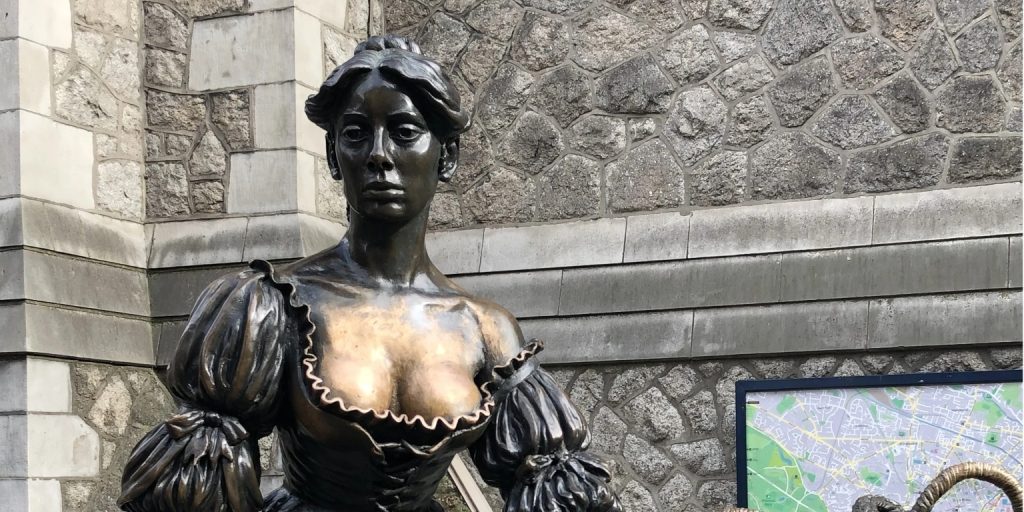
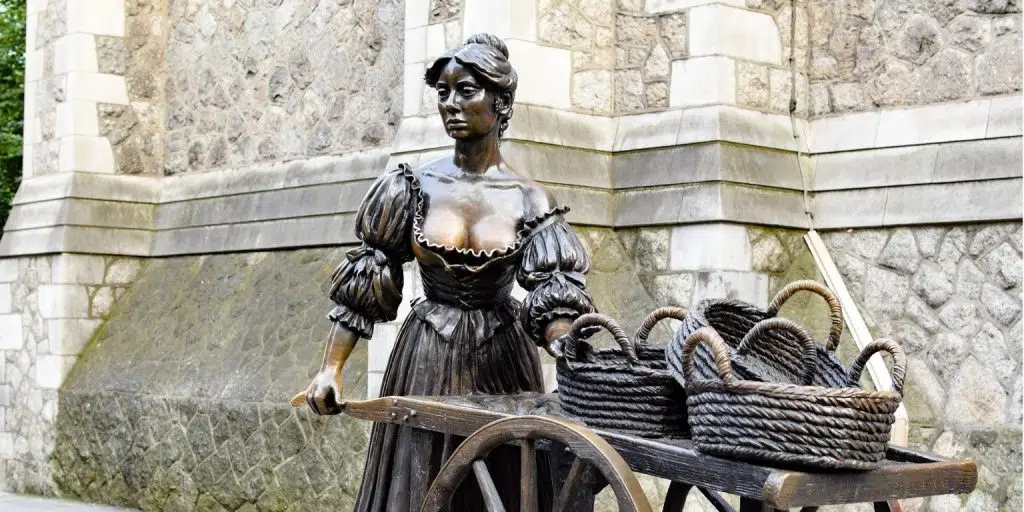
The statue was commissioned by the Jurys Hotel Group and designed by Irish artist Jeanne Rynhart to celebrate the Dublin Millennium in 1988. It was originally placed at the bottom of Grafton Street, the city’s premier shopping thoroughfare. The sculpture’s design is notable for its portrayal of Molly in a low-cut dress, which has led to its playful and sometimes controversial nickname among Dubliners, “The Tart with the Cart.” This provocative depiction alludes to the popular speculation that Molly led a double life, selling fish by day and working as a prostitute by night to make ends meet in a poverty-stricken city.
Rynhart, however, defended her design, stating that women in the 17th century breastfed publicly, and the dress was simply an accurate portrayal of period costume.
In 2014, the statue was moved to its current location on Suffolk Street to make way for the Luas Cross City tram line. This relocation, which saw the statue moved just a short distance, was met with mixed feelings but has since been accepted. The new location, right in front of the Dublin Tourist Information Centre and close to Trinity College, has made it an even more visible and accessible landmark for the countless tourists who visit the city.
A Modern-Day Tradition
The Molly Malone statue has become an unmissable part of the Dublin experience, drawing visitors who want to snap a photo and engage with the city’s folklore. A relatively new tradition, reportedly started by an imaginative tour guide, involves visitors rubbing the statue’s bronze bosom for good luck. This practice has become so popular that the statue’s chest has a distinct, golden sheen from the constant touching, standing in stark contrast to the dark patina of the rest of the sculpture. While some have criticized the tradition as objectifying, it has undoubtedly cemented the statue as an interactive and memorable part of a Dublin tour.
Beyond its artistic merit, the Molly Malone statue serves as a vital gathering point and a cultural anchor. It is a common meeting spot for locals and a starting point for many of the city’s walking tours. The area around the statue is always bustling with activity, from street performers serenading passersby with the famous song to tourists and students taking a moment to appreciate the lively atmosphere.
The Molly Malone statue is more than a simple monument; it is a physical embodiment of a city’s spirit. It stands for the enduring power of folklore, the resilience of a people, and the vibrant, often mischievous, personality of Dublin. For anyone exploring the city, a visit to this iconic sculpture is a perfect way to connect with the heart and soul of Dublin’s fair city.