
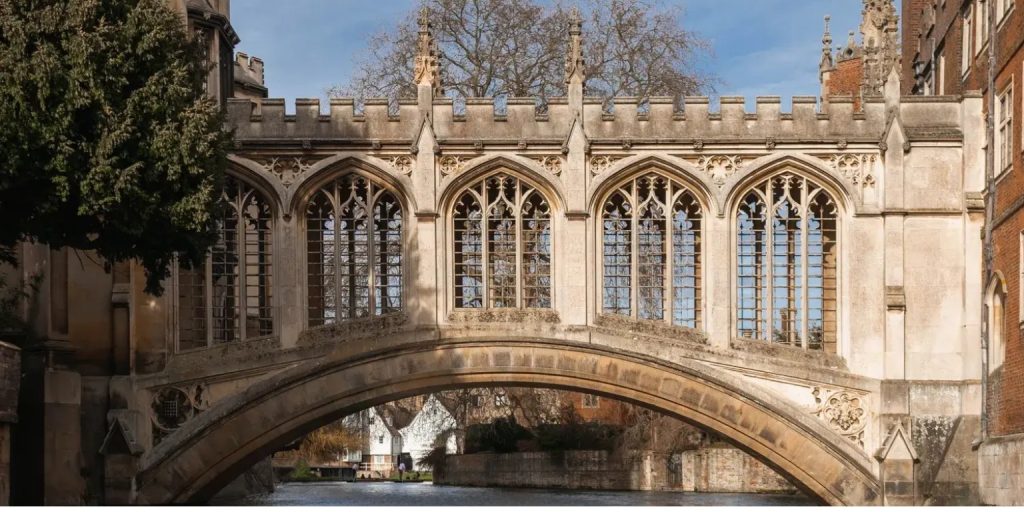
The Bridge of Sighs is a covered Gothic Revival bridge over the River Cam at St John's College, Cambridge, built in 1831 to link the college's old courts with its new buildings on the far bank. It is the only covered bridge across the Cam, and one of the most photographed sights in the city. Look at its windows: they are barred, perhaps to stop students climbing into college after the gates were locked at night.
The Bridge of Sighs at a glance
- Where: inside St John's College, crossing the Cam between Third Court and New Court, on the stretch of river known as the Backs.
- Built: designed in 1827 and completed in 1831.
- By: Henry Hutchinson, a pupil and partner of the architect Thomas Rickman; he died a few months after it was finished.
- What it is today: a Grade I listed college bridge, used every day by students and seen by most visitors from the river or from the neighbouring Kitchen Bridge.
- Time needed: 10 to 15 minutes from the Kitchen Bridge; longer if you see it from a punt.
From New Bridge to Bridge of Sighs
In the early 19th century St John's College ran out of space and built New Court on the west side of the Cam, in the meadows of the Backs. Henry Hutchinson designed both the new court and the bridge in the fashionable Gothic Revival style. Building them strained the college's finances so much that the downstream side of the bridge, which fewer people would see, was left in plain brick, while the upstream side received the full stone decoration.
At first it was simply called the New Bridge. When Queen Victoria visited in 1847 she compared it to the Bridge of Sighs in Venice, and the name stuck, even though the two have little in common beyond being covered bridges on arches. Around 1844 William Henry Fox Talbot, one of the pioneers of photography, took the first known photograph of it, and it has since appeared in films such as Elizabeth: The Golden Age (2007) and The Theory of Everything (2014).
What to look for
- The barred, open Gothic windows along both sides of the covered passage.
- The contrast between the richly carved stone of the upstream side and the plain brick of the downstream side, a sign of the college's tight budget.
- The single pointed arch over the water, framed by the walls of Third Court on one bank and New Court on the other.
- New Court itself, the large Gothic Revival block with its central tower, nicknamed the Wedding Cake by students.
- The Kitchen Bridge, about 20 metres upstream: built in 1709–1713 to a design by Sir Christopher Wren and the classic viewpoint for the Bridge of Sighs.
Cars under the bridge
Students of St John's have twice dangled a car from the bridge. In June 1963 a 1928 Austin 7 was floated down the river on four punts lashed together and hoisted up under the arch with ropes. In 1968 a three-wheeler car got the same treatment. Neither prank damaged the bridge, but both became part of Cambridge student folklore.
Tips for your visit
- The best views are from the Kitchen Bridge inside St John's College or from a punt on the Cam; the bridge itself is part of the college and not always open to visitors.
- St John's is a working college; visitor access depends on the season and on exams, so check before you go.
- Come early in the day: punts pile up under the bridge in the afternoon, especially in summer.
Nearby
- St John's College Chapel: a Victorian chapel by George Gilbert Scott with a tall tower, inside the same college.
- Round Church: one of only a few medieval round churches in England, a few minutes' walk from the college gate.
- Trinity College: the neighbouring college with its huge Great Court, just south of St John's.
- Quayside and Magdalene Bridge: the place to hire a punt or join a punting tour along the Backs.
See Cambridge with World City Trail
Our Cambridge scavenger hunt turns the city into a game you play on your phone. The route links 10 stops and takes around three hours, with about 35 minutes of walking. It includes places such as Parker's Piece and the Scott Polar Research Institute. You can play in English, German, French, Italian, Spanish or Dutch.
If you prefer a different format, Cambridge also has a self-guided walking tour and an outdoor escape game.
Play the Cambridge scavenger hunt →
Take the self-guided walking tour of Cambridge →
Play the outdoor escape game in Cambridge →
Facts checked in October 2026.